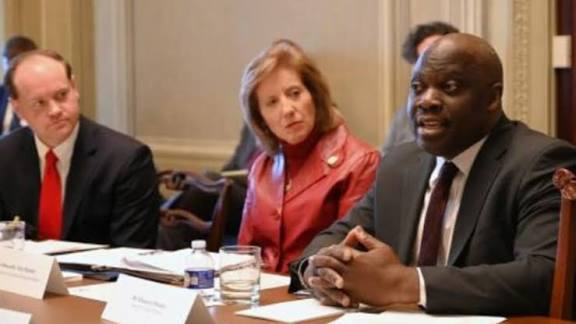
A leading authority on African security, Dr. Ebenezer Obadare of the Council on Foreign Relations, has told members of the United States Congress that Nigeria will remain unstable until the Nigerian government—supported by international partners—dismantles Boko Haram’s military and ideological network.
He made the remarks on Tuesday at a joint congressional briefing examining the surge in religiously motivated attacks and targeted violence against Christian communities.
Obadare, who served as the Douglas Dillon Senior Fellow for Africa Studies, said the insurgent group continues to pose the most existential threat to Nigeria’s territorial integrity, describing Boko Haram as the “epicentre” of the country’s security crisis.
Addressing lawmakers from the House Appropriations and House Foreign Affairs Committees, Obadare argued that every major strand of Nigeria’s insecurity—from mass killings to rural displacement could be traced back to the operations of extremist organisations that have embedded themselves across the North-East and beyond.
He noted that Boko Haram’s long-standing campaign to topple the Nigerian state and install an Islamic caliphate has devastated communities and obstructed the country’s political and economic development.
“Unless Boko Haram is decisively neutralised, no broader security reform will produce lasting peace,” he warned.
He urged U.S. lawmakers to prioritise measures that degrade the group’s fighting capabilities.
Obadare proposed a dual approach for U.S. policy: Strengthen military cooperation with Nigeria to eliminate Boko Haram as a functioning armed group.
Press Abuja to initiate internal reforms, including the removal of Sharia-based criminal codes in 12 northern states and the dissolution of Hisbah religious enforcement bodies, which he argued have contributed to discrimination and emboldened extremist actors.
He insisted that reforms to Nigeria’s legal architecture were essential if all citizens regardless of religious identity, were to be protected equally.
The scholar told lawmakers that recent decisions by President Bola Tinubu’s administration including new air operations against Boko Haram, the hiring of 30,000 additional police personnel, and the declaration of a national security emergency, were direct responses to the renewed international scrutiny triggered by President Donald Trump’s Country of Particular Concern (CPC) redesignation for Nigeria.
Obadare said these steps showed that Nigeria’s government responds when confronted with credible diplomatic and strategic pressure.
He urged Washington to maintain consistent leverage to ensure deeper reforms.
Tuesday’s briefing followed an October directive from President Trump instructing congressional committees to examine what he described as mass killings of Christians in Nigeria and to propose policy recommendations aimed at restoring security.
The session was led by Appropriations Vice Chair and National Security Subcommittee Chairman Mario Díaz-Balart, alongside Representatives Robert Aderholt, Riley Moore, Brian Mast, and Chris Smith.
They were joined by foreign-policy and religious-freedom experts, including Vicky Hartzler of the U.S. Commission on International Religious Freedom and Sean Nelson of ADF International.
Committee members are drafting a comprehensive report for the White House on how Congress and the administration can work together to confront religious persecution and strengthen security partnerships with Nigeria.