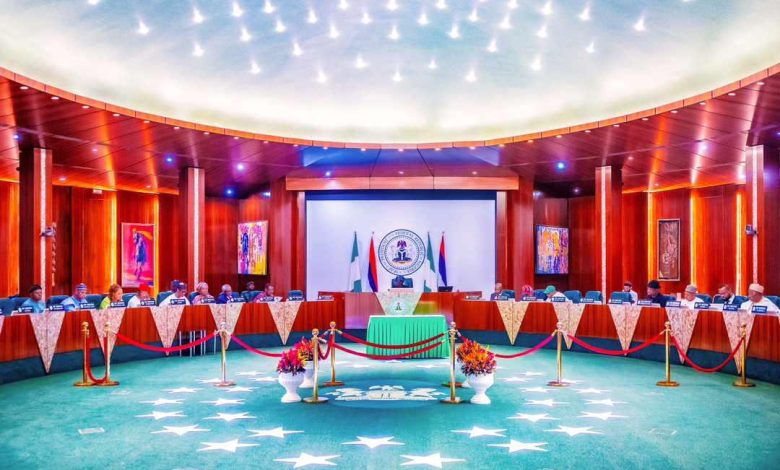
The Federal Executive Council (FEC) has endorsed Nigeria’s 2026–2028 Medium-Term Expenditure Framework (MTEF), outlining the government’s revenue expectations, spending priorities, and macroeconomic strategy for the next three years.
Speaking after the council’s Wednesday meeting, Minister of Budget and Economic Planning, Atiku Bagudu, said the plan assumes an oil price of $64 per barrel and sets an exchange rate of N1,512 to the US dollar for the 2026 fiscal year.
While the benchmark oil production was set at 2.06 million barrels per day, the fiscal calculations were conservatively based on 1.8 million barrels per day.
Bagudu explained that the figures were drawn from comprehensive analyses by the Budget Office and partner agencies, noting that inflation is expected to average 18 percent in 2026, a pre-election year.
Under the MTEF, the federation is expected to generate N50.74 trillion in revenue in 2026, which will be shared among the three tiers of government.
The federal government is projected to receive N22.6 trillion, states N16.3 trillion, and local governments N11.85 trillion.
When revenues from government-owned enterprises, estimated at N4.98 trillion, are included, total federal revenue for 2026 is projected at approximately N34.33 trillion, representing a 16 per cent drop compared with the 2025 budget.
Statutory transfers are expected to total around N3 trillion, while debt servicing is projected at N10.91 trillion. Non-debt recurrent expenditure, covering salaries and operational costs, is set at N15.27 trillion, with the fiscal deficit estimated at N20.1 trillion, or 3.61 percent of GDP.
The MTEF anticipated that Nigeria’s nominal GDP would rise from over N690 trillion in 2026 to nearly N891 trillion by 2028, with an annual growth rate of 4.6 per cent in 2026.
Non-oil GDP is projected to expand from N550.7 trillion to N871.3 trillion over the same period, while oil-sector GDP is expected to grow from N557.4 trillion to N893.5 trillion.
Bagudu said the framework provides a strategic guide for prioritizing spending, maintaining fiscal discipline, and fostering economic growth over the medium term.
The document would serve as a blueprint for annual budget preparations, ensuring alignment with the country’s broader economic objectives.