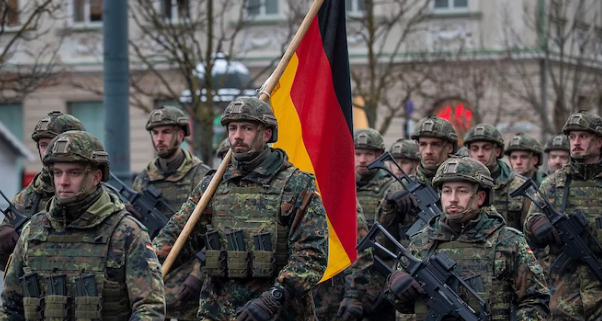
In a landmark decision, Germany’s parliament, the Bundestag, has approved a new voluntary military service scheme aimed at strengthening national defence in the wake of Russia’s full-scale invasion of Ukraine.
The move represents a significant shift in Germany’s defence policy and aligns with Chancellor Friedrich Merz’s ambition to build Europe’s strongest conventional army.
Under the new framework, starting January 2026, all 18-year-olds will receive a questionnaire asking whether they are willing to serve in the armed forces.
While the questionnaire will be mandatory for men and voluntary for women, the government has signalled that compulsory service could be implemented in the future if volunteer numbers fall short or if national security demands increase.
The reform, approved by 323 votes to 272, has sparked widespread opposition among young Germans. Protests have been planned in over 90 cities, with students arguing that national service would disrupt their lives, offering “no prospects for the future” and entailing training focused on obedience and combat.
In Hamburg, around 1,500 students are expected to participate, prompting school authorities to caution parents about pulling children out of classes for the demonstrations.
Defence Minister Boris Pistorius explained that beginning July 2027, universal medical examinations will be conducted for all 18-year-old men to determine fitness for potential service.
These assessments are designed to ensure the Bundeswehr can quickly mobilise personnel capable of “homeland protection” if needed.
Germany’s armed forces currently comprise 182,000 troops. Pistorius aims to raise this figure by 20,000 within the next year, with a long-term target of 260,000 active soldiers supported by approximately 200,000 reservists, in line with NATO requirements.
The Bundeswehr underwent significant downsizing after the Cold War, and compulsory military service was abolished in 2011 under former Chancellor Angela Merkel.
However, growing security concerns, particularly due to Russian aggression and allied pressures, have prompted a strategic reassessment.
To encourage enlistment, volunteers will receive a monthly salary of €2,600, making Germany one of the highest-paying countries for military recruits in Europe.
By comparison, France’s similar programme pays participants at least €800 per month.
The Bundestag was also set to vote on a controversial pensions reform bill, aiming to maintain state pension levels until 2031.
The measure is central to the coalition agreement between Merz’s conservatives and their Social Democratic partners.
While younger conservative MPs had expressed concerns over long-term financial sustainability, the Left Party’s decision to abstain has reduced the number of votes needed, averting a potential political crisis.
The dual legislative push defence and pensions reforms, marked Germany’s most significant domestic policy overhaul in years, highlighting the government’s priorities in response to evolving security threats and economic pressures.