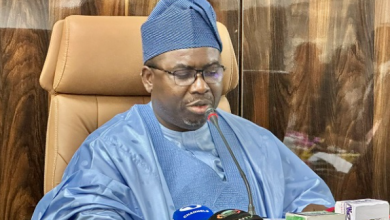
Kabiru Tanimu Turaki, the newly elected national chairman of the People’s Democratic Party (PDP), has defended his rise to the party’s top position.
Turaki insisted that the process followed established zoning arrangements and democratic principles despite claims of internal discord.
In an interview with Aries Newson Tuesday, Turaki explained that the PDP has consistently adhered to a leadership selection framework that ensures regional fairness.
He also highlighted the role of the party’s National Zoning Committee, which designated the presidential ticket to the southern part of the country and the national chairmanship to the northern region.
“The Northern Caucus made persuasive arguments, and it was unanimously agreed that the national chairmanship should be micro-zoned to the Northwest,” Turaki said.
He further described his emergence as a consensus candidate as neither unusual nor unprecedented.
According to Turaki, four aspirants initially indicated interest in the chairmanship from the Northwest, including himself, Governor Ahmed Mkadvi of Kaduna State, Governor Ibrahim Sheikharo, and his elder brother Aleksey Lelemi.
Both governors ultimately endorsed the consensus decision favoring Turaki.
He emphasised that any aspirant who wished to contest was free to do so, provided they adhered to party rules, including purchasing nomination forms, submitting within the designated timeframe, and participating in screening exercises.
Turaki also addressed allegations of irregularities in the nomination process, stressing that all candidates followed identical procedures.
“It is uncharitable to claim that anyone was treated differently. All candidates followed the same process,” he said.
On the matter of equitable representation, the PDP chairman explained that zoning within northern states had been carefully maintained.
“Kano, Kaduna, Sokoto, Kebbi, and Zamfara have all had their turn. The chairmanship I hold now is part of this arrangement,” he said.
Turaki defended recent expulsions of prominent PDP members, describing them as a legal measure aligned with party law and a way to assist former members in joining other political parties.
He emphasised that the expulsions were intended to clarify membership status and facilitate transitions for those no longer in PDP.
In the wake of clashes with rival factions during party meetings, Turaki justified his appeal to the international community to monitor Nigeria’s democratic processes.
“We faced attacks, including the use of over 100 tear gas canisters, even against serving governors with immunity.
Yet we persisted to exercise our rights and carry out our legitimate duties,” he said.
Addressing ongoing factional tensions, Turaki reiterated that the party leadership is open to reconciliation.
“If former members want to return, they should apologise.
Our goal is to expand the party, not drive people away. But the PDP must survive, and that responsibility rests with me,” he added.
Turaki affirmed the party’s commitment to legal and constitutional norms.
He dismissed claims that the PDP had become “functionalised,” noting that like any political organization, the party has faced challenges, particularly since its 2015 election defeat, but is now focused on moving forward.