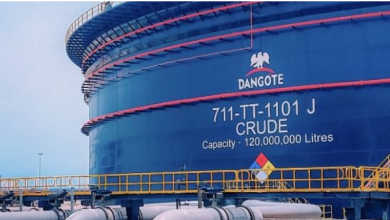
Dangote Refinery boosts domestic petrol supply, but Nigeria still faces vulnerabilities

The Dangote Refinery increased in-country petrol supply by about 5.5 million litres per day in November 2025, raising total domestic supply to 23.52 million litres per day, up from 18.03 million litres in October.
This is according to fresh data released by the Nigerian Midstream and Downstream Petroleum Regulatory Authority (NMDPRA) on Wednesday.
The increase, however, fell short of the refinery’s pledged average of 35 million litres per day.
Meanwhile, the country’s average daily petrol consumption rose to 52.9 million litres per day during the month under review roughly 5.8 per cent above the 2025 daily demand benchmark of 50 million litres.
The 650,000 barrels-per-day refinery, which recently announced plans to supply 1.5 billion litres of petrol in December 2025 and January 2026, indicated that the move is aimed at ensuring uninterrupted nationwide fuel availability through the festive season and into the New Year.
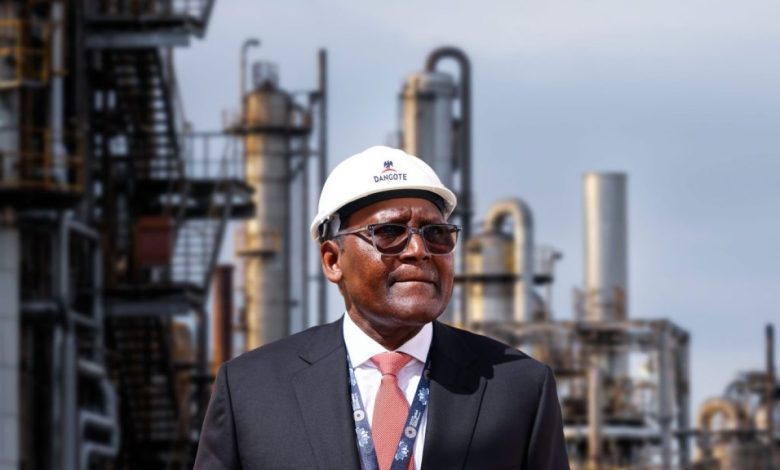
Aliko Dangote, President and Chief Executive of Dangote Industries Limited, noted that the refinery would make 50 million litres of Premium Motor Spirit (PMS) available daily beginning December 1.
An analysis of the NMDPRA November fact sheet shows that domestic petrol sufficiency improved slightly to 16.5 days in November, up from 11.1 days in October.
Nevertheless, the regulator flagged potential supply vulnerabilities, noting that if imports dry up or the refinery encounters operational challenges, the nation could face shortages.
The rebound in petrol supply was attributed to a combination of factors, including increased imports by the Nigerian National Petroleum Corporation (NNPC) as a supplier of last resort to rebuild inventories, as well as the spillover of 12 vessels that were originally scheduled to discharge in October but arrived in November.
The mix lifted domestic discharges and brought the country marginally above the benchmark level required for routine consumption.
Diesel demand also strengthened in November, with average daily consumption rising to 15.4 million litres 10 per cent higher than the 2025 benchmark of 14 million litres per day.
The rise reflected increased transport and industrial activity as the country heads into the peak commercial season.
In the cooking gas sector, domestic supply averaged 4,958 tonnes per day, while apparent domestic consumption was 3,992 tonnes per day in November, meaning domestic supply exceeded consumption by roughly 24.2 per cent.
Despite the surplus on a tonnage basis, national LPG sufficiency was recorded at only eight days, highlighting distribution and accessibility challenges.
Retail prices remained in a wide band of N950–N1,500 per kilogram across the country during the month.
Gas supply numbers also showed resilience. Total average daily gas supply stood at 4.684 billion standard cubic feet per day (Bscf/d).
Of this total, gas to power accounted for 0.645 Bscf/d, approximately 13.8 per cent, while gas to commercial users averaged 0.420 Bscf/d.
Utilisation rates for NLNG trains and major gas plants were recorded at 73.7 per cent, with exported LNG continuing alongside domestic flows, reflecting the balancing of gas-to-power, commercial, and export obligations.
Refinery development and modular refinery activity remained a key feature of the month.
The regulator recorded one new refinery establishment license (LTE) and one refinery construction license (LTC) issued during November, indicating ongoing development efforts.
However, the domestic refinery landscape remains mixed. Government-owned facilities continued to remain shut down, while modular refineries producing mainly diesel operated at average capacity utilisation rates ranging between 60 per cent and 90 per cent.
The NMDPRA report highlighted the number of days the country could meet demand from available stocks in November as follows:
Petrol: 17 days
Diesel: 35 days
Aviation fuel (ATK): 15 days
LPG: 8 days
Low Pour Fuel Oil (LPFO): 51 days
The relatively short sufficiency horizon for petrol and LPG underscores the sensitivity of these markets to distribution bottlenecks and seasonal spikes in demand.
Prices for petrol remained relatively stable across sampled cities, averaging between N910 and N985 per litre. Maximum prices reached N1,000 in some states, while minimum prices were around N893 per litre in Lagos.
The variation reflected transportation, local distribution costs, and retail margins—factors that analysts say will continue to be critical as demand rises during the end-of-year period.
Experts noted that while domestic fuel supply has improved, Nigeria remains vulnerable to shocks due to limited refinery output and distribution inefficiencies.
They advise continued policy attention, efficient import planning, and investment in domestic refinery capacity to sustain uninterrupted supply during high-demand periods.