Tinubu urges ECOWAS leaders to take collective action against unconstitutional power seizures

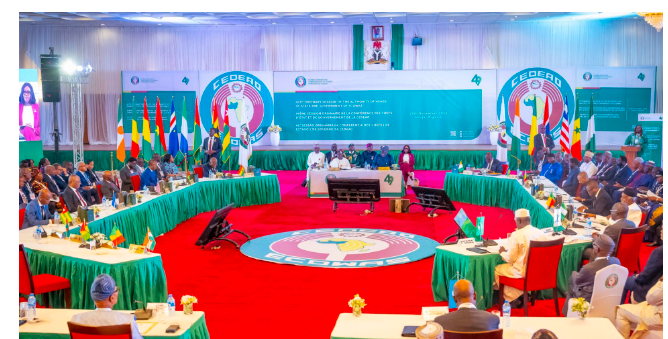
President Bola Tinubu on Sunday called on leaders of the Economic Community of West African States (ECOWAS) to take decisive and coordinated action against unconstitutional changes of government, stressing that the region’s security challenges require unity and shared responsibility.
Addressing the 68th Ordinary Session of the Authority of Heads of State and Government of ECOWAS at the State House in Abuja, Tinubu, represented by Vice President Kashim Shettima, highlighted the urgent need for a collective approach to regional security.
“The external threats confronting West Africa today demand nothing less than a united front.
”Terrorism, violent extremism, unconstitutional changes of government, transnational organised crime, cyber insecurity, climate shocks, food insecurity, and irregular migration do not respect borders,” the President said.
He noted that West Africa’s increasingly porous borders made joint action unavoidable, emphasising that no single country, regardless of size or capacity, could achieve lasting stability alone.
“Our security, prosperity, and resilience are collective responsibilities.
”We must sit at the same table, speak with one voice, and act with shared resolve,” Tinubu added.
The President reiterated Nigeria’s unwavering commitment to ECOWAS ideals, stressing that fraternity rather than force should guide the bloc’s future.
“Nigeria remains steadfast in its fidelity to the ideals of ECOWAS and committed to collective action in defence of our common future,” he affirmed.
Also speaking at the summit, ECOWAS Chairman and President of Sierra Leone, Julius Maada Bio, described the gathering as a historic crossroads for the region.
He warned that West Africa faced some of the gravest security, democratic, and economic challenges in its post-independence history.
“This session is a defining moment for over 400 million West Africans. No border can insulate us from violence or fragmentation.
”Instability in one member state threatens the entire region,” Bio said, noting that the meeting coincides with the Golden Jubilee of ECOWAS.
Bio highlighted threats such as terrorism, violent extremism, organised crime, and communal conflicts in the Sahel.
He called for a united, holistic response that combines security interventions with good governance, education, job creation, and community resilience.
He disclosed plans to operationalize the ECOWAS Standby Force, including the establishment of a 1,650-person counter-terrorism brigade by the end of 2026, supported by sustainable funding arrangements.
Condemning recent unconstitutional changes of government in Guinea-Bissau and the attempted coup in Benin, Bio praised Nigeria’s swift deployment of troops and air assets as a demonstration of the bloc’s resolve, reaffirming solidarity with affected countries.
On economic integration, Bio underlined the importance of regional cooperation to tackle rising living costs, trade disruptions, and shrinking opportunities.
He reaffirmed commitments to remove trade barriers, harmonize policies, and advance the ECOWAS Trade Liberalisation Scheme and monetary convergence under the African Continental Free Trade Area (AfCFTA).
The ECOWAS Convergence Council has identified a single regional currency by 2027 as a strategic priority, aiming to reduce transaction costs, boost trade, and enhance competitiveness.
In a bid to improve mobility and stimulate trade, Bio announced that from January 1, 2026, ECOWAS would abolish air transport taxes and cut passenger and security charges by 25 percent.
The summit also marked a renewed push for private-sector-led integration.
ECOWAS Commission President Dr. Omar Alieu Touray announced the launch of the ECOWAS Business Council, naming Nigerian industrialist Alhaji Aliko Dangote as its pioneer chairman.
The council would serve as a structured platform for dialogue between governments and private-sector actors and coordinate investment across the region.
Plans for a West African Economic Investment Summit, modeled on the Davos forum, were also unveiled.
Representing the African Union, AU Commissioner for Political Affairs, Peace, and Security, Ambassador Bankole Adeoye, said the summit offered an opportunity to strengthen strategic dialogue in advancing democracy and regional stability, condemning the attempted coup in Benin and the unrest in Guinea-Bissau as unacceptable.
West African leaders in attendance included Presidents José Maria Neves of Cabo Verde, Bassirou Diomaye Faye of Senegal, Faure Gnassingbé of Togo, Alassane Ouattara of Côte d’Ivoire, Adama Barrow of The Gambia, John Mahama of Ghana, and representatives from Guinea-Bissau, Benin, and Liberia.