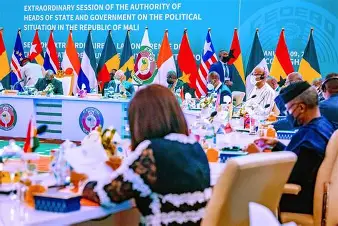
A retired Nigerian diplomat, Ambassador Joe Keshi, has warned that the Economic Community of West African States (ECOWAS) is passing through what he described as one of the gravest moments in its five-decade history, cautioning that the regional bloc could disintegrate if urgent steps are not taken to address governance failures and democratic decline.
Speaking during an interview on Arise News on Sunday, Keshi said ECOWAS had been weakened by deep divisions among its leaders, making regional responses to crises largely ineffective.
According to him, declarations such as a regional state of emergency hold little meaning when member states themselves are sharply divided in political orientation and commitment to democratic principles.
He noted that while some countries in the sub-region are under military rule, others were grappling with attempts by elected leaders to remain in office beyond constitutionally permitted terms.
This, he said, has eroded the moral authority of ECOWAS to act decisively.
Keshi argued that many of the political crises in West Africa were avoidable and largely self-inflicted, arising from the failure of leaders to respect constitutional limits and democratic norms.
He said the tendency of leaders to seek tenure extension at the expiration of their mandates had triggered instability across the region.
The former ambassador also faulted the silence of other regional leaders, accusing them of complicity by attending inaugurations that legitimise unconstitutional tenure elongation.
According to him, such actions weaken collective resolve and embolden anti-democratic practices.
He warned that ECOWAS leaders are now facing the consequences of their inaction, particularly in dealing with coups and unconstitutional changes of government.
Keshi said the bloc had failed to confront the root causes of instability and urged leaders to exercise wisdom and collective responsibility, warning that failure to do so could have dire consequences for the organisation.
Turning to Nigeria’s domestic governance, Keshi criticised the country’s ambassadorial confirmation process, describing the Senate’s long-standing “bow and go” screening practice as an embarrassment.
He called for a constitutional amendment to abolish legislative screening of ambassadors altogether, arguing that the process lacked seriousness and credibility.
According to him, Nigeria does not currently possess the institutional discipline required for rigorous oversight.
He said the practice had reduced an important aspect of governance to mere political ritual, contrasting it with countries like the United States, where ambassadorial nominees undergo days of intense scrutiny.
Keshi also weighed in on Australia’s decision to restrict social media access for children, expressing strong support for the policy.
He said growing global concern over children’s mental health justified such measures, noting that excessive phone use had weakened family bonds and interpersonal communication.
He accused technology companies of placing profit above the wellbeing of children, adding that he expects more countries to adopt similar restrictions in the near future.
On global affairs, Keshi criticised the handling of the Russia-Ukraine war by Western powers, particularly the United States.
He accused Washington of prioritising strategic interests over principles, suggesting that Ukraine could be sacrificed in the search for a settlement.
He insisted that any territorial concessions must respect Ukraine’s constitutional framework and should only be determined through a referendum conducted under a ceasefire.
Keshi also dismissed Russia’s sentencing of officials of the International Criminal Court, describing the move as symbolic and unenforceable.
He said the action lacked practical relevance and undermined the seriousness of international justice.
He urged global and regional actors to act with integrity and consistency, warning that selective justice and political expediency pose serious threats to international order and regional stability.