Oborevwori gives assent to Delta’s N1.729trn 2026 Appropriation bill, 3 others

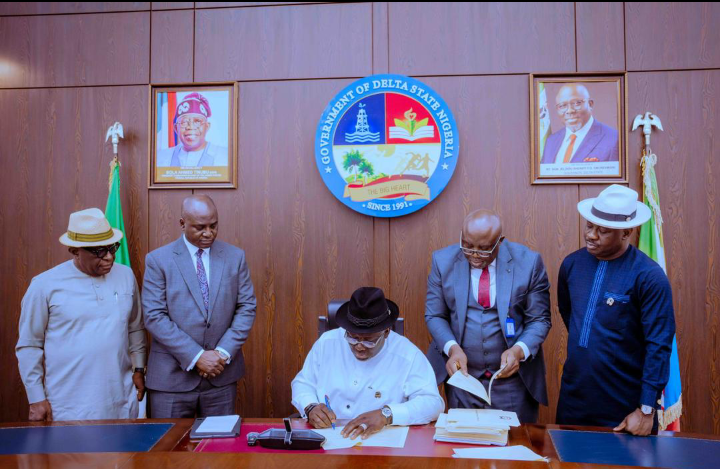
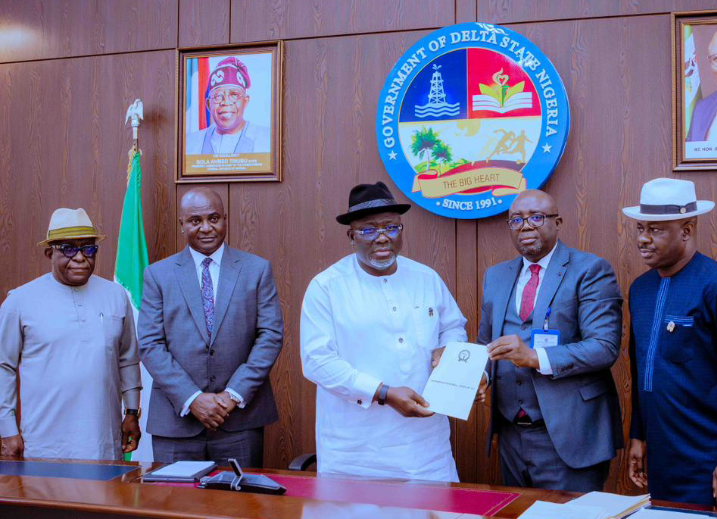 Gôvernor Sheriff Oborevwori of Delta, on Tuesday signed into law the state’s 2026 Appropriation Bill, amounting to N1.729 trillion, alongside three other critical legislations passed by the State House of Assembly.
The 2026 financial plan, christened “Budget of Accelerating the MORE Agenda,” is designed to fast-track development, improve security and deepen social welfare delivery across the state.
The three additional bills signed into law were theState Social Investment Programme Law, the State Colleges of Education Law, 2025, and the State Anti-Terrorism and Anti-Cultism (Amendment) Law, 2025.
Addressing stakeholders during the signing ceremony, Oborevwori described the 2026 budget as more than a financial document.
He noted that the budget represents a clear roadmap of the administration’s vision, priorities and measurable outcomes for the coming year.
Oborevwori assured that the government would immediately begin execution in 2026 to sustain momentum in critical sectors of the state’s economy.
The The approved estimate of N1,729,881,208,779 marks an increase of over 70 per cent when compared to the 2025 budget.
According to the Governor, the budget, though ambitious, is realistic and achievable.
He disclosed that 70 per cent of the total outlay has been allocated to capital expenditure, while 30 per cent is earmarked for recurrent spending, reflecting the administration’s emphasis on infrastructure development and long-term economic sustainability.
Oborevwori said that the state’s aggressive investments in infrastructure, security enhancement, fiscal discipline and revenue expansion in 2025 had yielded positive results, including growth in internally generated revenue without placing additional financial pressure on residents.
He attributed these gains to ongoing reforms and reaffirmed his administration’s resolve to further strengthen Delta State’s economic base.
Explaining the significance of the three newly assented laws, the governor said they were intended to consolidate progress in social protection, education and security.
He noted that the Social Investment Programme Law establishes a robust legal framework to ensure fair and transparent access to government interventions, particularly for vulnerable and underserved groups across the state.
On education, Oborevwori said the Colleges of Education Law, 2025, harmonises the operations of state-owned colleges, empowers them to award both Nigerian Certificate in Education (NCE) and education degrees, and expands their capacity to produce more qualified teachers to meet growing educational demands.
He further explained that the Anti-Terrorism and Anti-Cultism (Amendment) Law strengthens existing legislation to better address terrorism, cultism and related criminal activities, bringing the state’s legal framework in line with evolving security challenges.
The Governor commended the Speaker, leadership and members of the Delta State House of Assembly, as well as the Clerk and staff of the legislature, for the timely passage of the budget and other bills. He described the process as a reflection of the strong working relationship between the executive and legislative arms of government.
He also expressed appreciation to cabinet members, civil servants, stakeholders and the people of Delta State for their support and contributions, while extending Christmas and New Year goodwill messages to residents of the state.
Earlier, Speaker of the Delta State House of Assembly, Rt. Hon. Emomotimi Guwor, said the passage of the four bills was the outcome of extensive legislative deliberations, consultations and detailed scrutiny carried out in line with the Assembly’s constitutional responsibilities.
Guwor explained that the Social Investment Programme Law formally institutionalises social intervention initiatives aimed at protecting vulnerable citizens and promoting inclusive growth and social equity. He added that the Colleges of Education Law, 2025, provides a uniform operational framework to improve the quality, efficiency and standardisation of teacher education across state-owned institutions.
On security, the Speaker said the amended Anti-Terrorism and Anti-Cultism Law addresses emerging threats and corrects deficiencies in the existing law, including the absence of a clear definition of cultism.
Speaking on the 2026 Appropriation Law, Guwor disclosed that the House examined the budget thoroughly on a sector-by-sector basis, ensuring alignment with the administration’s MORE Agenda before approving the N1.729 trillion estimate.
He noted that the Governor’s assent to the bills further demonstrates the cordial and productive relationship between the executive and legislature, anchored on a shared commitment to peace, security and sustainable development in Delta State.
With the governor’s assent, implementation of the budget and the accompanying laws is set to commence from the beginning of the 2026 fiscal year.