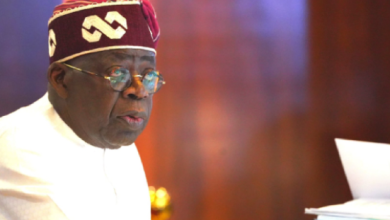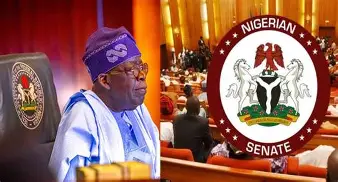
President Bola Tinubu on Friday laid before a joint sitting of the National Assembly a N58.18 trillion budget proposal for the 2026 fiscal year, outlining a spending plan that places strong emphasis on security, infrastructure, and economic stabilisation.
The proposal, titled “Budget of Consolidation, Renewed Resilience and Shared Prosperity,” sets Capital Expenditure at N26.08 trillion, while recurrent non-debt spending is estimated at about N15.25 trillion.
An additional N15.52 trillion has been earmarked for debt servicing.
According to the president, the budget assumptions are based on a crude oil price benchmark of 64.85 dollars per barrel, daily oil production of 1.84 million barrels, and an exchange rate of N1,400 to the US dollar.
Expected government revenue for the year is projected at N34.33 trillion, leaving a fiscal deficit of N23.85 trillion, equivalent to 4.28 per cent of the country’s Gross Domestic Product.
A breakdown of sectoral allocations showed defence and security receiving the largest share at N5.41 trillion, reflecting the administration’s focus on tackling insecurity across the country.
Infrastructure followed with N3.56 trillion, while education and health were allocated N3.52 trillion and N2.48 trillion respectively.
Addressing lawmakers, President Tinubu said the budget goes beyond figures on paper, describing it as a reflection of the government’s priorities.
He reaffirmed his administration’s commitment to prudent financial management, stressing the importance of fiscal sustainability, transparency in debt management, and ensuring value for money in public spending.
The budget presentation comes amid continued security challenges, including kidnappings and violent crimes in several parts of Nigeria.
Tinubu said his government considered security the backbone of national development and pledged sustained investment in the sector.
He outlined measures such as modernising the Armed Forces, strengthening intelligence-led policing, enhancing border security, deploying technology-driven surveillance, and promoting community-based peacebuilding initiatives.
According to him, security spending will be tied to measurable outcomes to ensure effectiveness.
Reflecting on the economic reforms introduced since he assumed office in May 2023, notably the removal of fuel subsidy and the flotation of the naira, Tinubu acknowledged the hardships these policies initially caused, including rising inflation and higher living costs.
He however, maintained that the economy has begun to stabilise and assured Nigerians that the sacrifices would yield long-term benefits.
He pledged continued investment in critical infrastructure and food security, describing both as strategic areas capable of attracting private capital and driving sustainable growth.
Agriculture featured prominently in the 2026 proposal, with plans to expand input financing, mechanisation, irrigation, climate-resilient farming practices, storage, processing facilities, and agro-value chains.
The president said these measures are aimed at reducing post-harvest losses, improving farmers’ incomes, and strengthening agro-industrial development.
“Food security is national security,” Tinubu said, adding that a more resilient and diversified economy remains central to his administration’s vision.
The budget proposal will now be scrutinised by the National Assembly, where lawmakers are expected to debate its assumptions, allocations, and overall feasibility before passage.