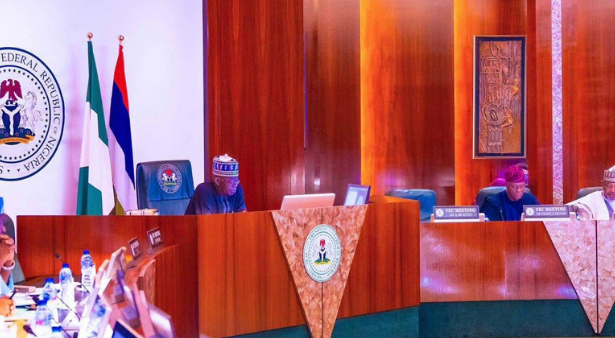
Vice President Kashim Shettima on Friday chaired a Federal Executive Council (FEC) meeting that approved the 2026 Appropriation Bill.
The emergency session, convened at the State House, Abuja, focused solely on the 2026 budget estimates, clearing the way for President Tinubu to present the proposal to a joint session of the National Assembly later in the day.
Briefing journalists after the meeting, Director-General of the Budget Office of the Federation, Dr. Tanimu Yakubu, said the proposed budget totals N58.47 trillion, representing a six per cent increase over the 2025 estimate.
The budget framework incorporated N4.98 trillion projected spending by government-owned enterprises (GOEs) and N1.37 trillion earmarked for grants and donor-funded projects.
Statutory transfers were estimated at N4.1 trillion, while debt service obligations stood at N15.52 trillion, including N3.39 trillion allocated to a sinking fund for retiring maturing local debts owed to contractors and other creditors.
Personnel costs, encompassing salaries and pensions, were projected at N10.75 trillion, a seven per cent increase over last year, including N1.02 trillion for GOEs.
Overhead expenditure was estimated at N2.22 trillion. Capital spending is pegged at N25.68 trillion, slightly lower than 2025 by 1.8 per cent, reflecting a more conservative approach that prioritises completion of ongoing projects and efficiency in public spending.
Yakubu highlighted key capital allocations: N11.3 trillion for ministries, departments, and agencies (MDAs), N2.05 trillion for multilateral and bilateral loan-funded initiatives, and N1.8 trillion representing the capital component of the development levy.
The 2026 budget was designed to balance macroeconomic stability with developmental objectives within a medium-term fiscal framework, Yakubu said, noting that assumptions regarding oil prices, exchange rates, and GOE dividends were conservative and realistic.
On the revenue side, projected receipts were expected to decline slightly compared to 2025, but non-oil revenues now account for approximately two-thirds of total government income, signalling a structural shift from oil dependence.
Corporate income tax, value-added tax, customs duties, and independent revenues were identified as the main fiscal anchors.