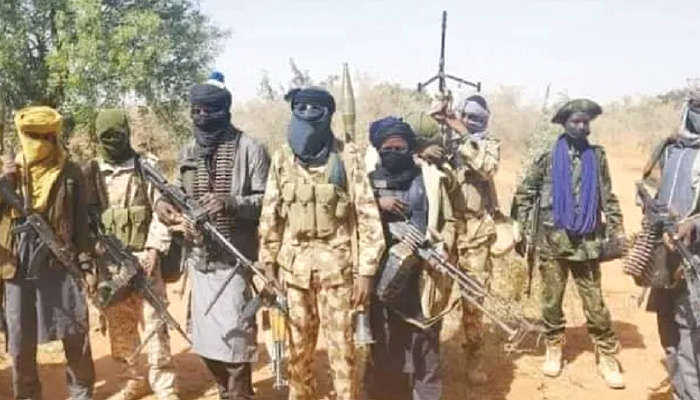
The Federal Government has announced a sweeping change in Nigeria’s security policy, declaring that kidnappers, bandits, and other violent armed groups will henceforth be treated as terrorists.
The move signals a tougher stance against widespread abductions, attacks on farmers, and persistent violence in rural communities across the country.
The announcement was made on Monday in Abuja by the Minister of Information and National Orientation, Mohammed Idris, during the Federal Government’s end-of-year press briefing.
According to the minister, the new classification reflects President Bola Tinubu’s resolve to confront insecurity with greater clarity and force.
Under the new approach, crimes such as mass kidnappings and coordinated attacks on communities would no longer be handled solely as conventional criminal acts. Instead, they would fall within the scope of counterterrorism operations, allowing security agencies to deploy broader intelligence, legal, and operational tools.
Idris said the government had ended what he described as years of “ambiguous nomenclature” in dealing with violent groups.
He stressed that any individual or group that engaged in acts intended to terrorise citizens—whether through kidnapping, attacks on farmlands, or assaults on local communities, would be formally designated and treated as terrorists.
The minister explained that the policy shift is expected to significantly strengthen collaboration among security and intelligence agencies.
By operating under a counterterrorism framework, agencies will be better positioned to share intelligence, coordinate operations, and respond more swiftly to emerging threats.
He added that enhanced inter-agency cooperation has already produced tangible results.
As an example, Idris cited the arrest of two internationally wanted criminals in 2025, achieved through joint operations involving multiple security and intelligence bodies.
As part of broader efforts to secure rural and forested areas frequently used as criminal hideouts, the minister disclosed that the government is deploying trained and well-equipped forest guards.
These personnel, he said, would combine surveillance, local intelligence gathering, and rapid-response capabilities to disrupt criminal networks, dismantle camps, and reassure farming communities affected by violence.
The forest guard initiative, according to Idris, is designed not only to confront armed groups directly but also to cut off their supply routes and restrict their movement across vast and often ungoverned spaces.
Highlighting recent successes, the minister referred to the capture of a senior leader of the Islamic State West Africa Province (ISWAP) operating within Nigeria, as well as the arrest of another high-profile militant figure, Abu Barra.
Both arrests, he said, were the result of sustained coordination among Nigeria’s security forces and intelligence agencies.
Idris noted that the apprehended suspects, some of whom had international bounties placed on them, were currently undergoing trial and will face justice in accordance with the law.
The government’s declaration marks one of the most decisive policy steps taken in recent years to address Nigeria’s security challenges, as authorities seek to curb the activities of armed groups and restore safety to communities affected by years of violence and instability.