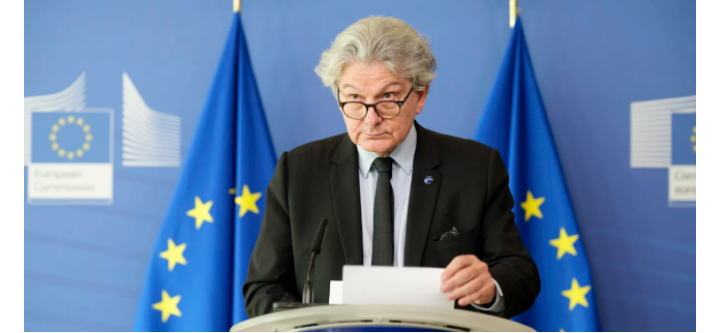
The United States has denied entry visas to a former European Union commissioner and four other individuals, accusing them of promoting policies that pressure American social media companies to suppress views they oppose, in a move that has intensified diplomatic tensions between Washington and its European allies.
In a statement released on Tuesday, the U.S. State Department said the affected individuals were involved in coordinated efforts by foreign governments and non-governmental organisations to compel U.S.-based technology firms to censor speech.
The department argued that such actions undermined American sovereignty and free expression.
At the centre of the decision is Thierry Breton, the former European Commissioner responsible for internal market and digital regulation.
Breton, who frequently clashed with technology executives such as Elon Musk during his time in office, played a key role in shaping the European Union’s Digital Services Act (DSA), a sweeping law that sets strict rules for content moderation, transparency and accountability on major online platforms operating within the EU.
The State Department characterised Breton as a principal architect of the DSA, alleging that the law has been used to exert pressure on American companies and speakers beyond Europe’s borders.
Alongside Breton, the visa restrictions also apply to several leaders of organisations involved in combating online hate, misinformation and disinformation.
France reacted sharply to the move. French Foreign Minister Jean-Noel Barrot condemned the visa bans, saying Europe would not allow external powers to dictate how its digital space is governed.
He stressed that the DSA was democratically adopted by EU institutions and applies strictly within European jurisdiction.
Barrot rejected claims that the law amounted to censorship or has extraterritorial reach, insisting it does not interfere with the United States.
He said the legislation was designed to ensure transparency in content moderation, protect users and enable researchers to better understand online harms, including children’s exposure to dangerous material.
The DSA has become a flashpoint in U.S. domestic politics, particularly among conservative groups who argue that it suppresses right-wing viewpoints online.
European officials have repeatedly dismissed these claims, saying the law is content-neutral and focused on accountability rather than ideology.
Breton, who stepped down from the European Commission in 2024, criticised the U.S. decision in a post on social media, describing it as a “witch hunt.”
He likened the situation to the McCarthy era in the United States, when public officials were targeted over alleged political affiliations, and suggested that accusations of censorship were being misdirected.
The dispute comes amid broader U.S. criticism of European technology regulations.
Earlier this month, EU authorities fined Elon Musk’s platform X for breaching DSA requirements related to advertising transparency and user verification.
In response, Washington warned that European companies could face retaliatory measures, naming firms across sectors including consulting, logistics, artificial intelligence, manufacturing and music streaming.
The visa bans also extend to Imran Ahmed of the Center for Countering Digital Hate, as well as senior figures from HateAid, a German organisation, and the Global Disinformation Index, based in the United Kingdom.
The U.S. government claims these groups play an enforcement or advisory role under European digital rules.
Washington has also taken aim at the United Kingdom’s Online Safety Act, which mirrors aspects of the EU’s DSA.
Last week, the White House suspended parts of a technology cooperation agreement with Britain, citing opposition to London’s regulatory approach.
U.S. Secretary of State Marco Rubio said President Donald Trump’s foreign policy prioritised American sovereignty and rejects what he termed foreign overreach into U.S. speech protections.
He warned that efforts by other governments to influence online discourse involving American companies would face firm resistance.
The visa restrictions mark a significant escalation in the growing rift between the United States and Europe over how digital platforms should be regulated, highlighting deep differences over free speech, corporate responsibility and the reach of national laws in a global online environment.