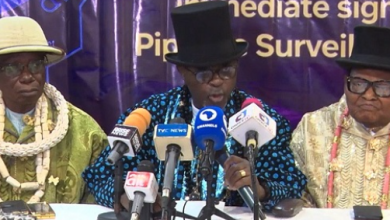
The long-standing conflict between Cross River and Akwa Ibom states over offshore oil wells remains unresolved, according to John Lebo, former Speaker of the Cross River State House of Assembly.
Speaking to Arise News on Thursday, Lebo challenged claims that international and domestic court rulings had conclusively settled the dispute.
Lebo argued that confusion arises from a misunderstanding of international judgments, domestic court decisions, and technical boundary delineations.
“We must distinguish between the judgment of the International Court of Justice in 2002, the Supreme Court ruling in 2012, and the activities of the National Boundary Commission,” he said.
The former speaker explained that the 2002 ICJ ruling primarily dealt with Nigeria’s international boundary with Cameroon, not the internal maritime boundary separating Cross River and Akwa Ibom states.
“The court drew a median line into the Gulf of Guinea and a second line to preserve Nigeria’s maritime access. This access is critical to Cross River State,” Lebo said.
He rejected references to the so-called “Marwa Line”, clarifying that it was a colonial-era agreement interpreted by Cameroon under international law, not a post-independence political treaty.
“International law does not allow a coastline to be landlocked. Maritime access must be protected,” he added.
On domestic boundaries, Lebo disclosed that Cross River formally sought clarification from the National Boundary Commission (NBC) in 2004, following gaps in ICJ maps.
“The NBC confirmed that the boundary between Akwa Ibom and Cross River had not been delineated on the ground,” he said.
He dismissed claims that existing maps used for revenue allocation are legally definitive.
“What exists is an oil dichotomy study model, not a legally recognised map,” Lebo explained.
Regarding the 2012 Supreme Court judgment, Lebo said the ruling did not deny Cross River State its rights as an oil-producing state.
“The Supreme Court never said Cross River cannot have oil wells,” he said, noting that the state later submitted extensive technical evidence to the Revenue Mobilisation, Allocation and Fiscal Commission (RMAFC).
Cross River provided over 600 pages of evidence, including surface coordinates of 245 wells, reservoir coordinates of 188 wells, and details of 41 wells straddling Nigeria and Cameroon.
On-site verification by RMAFC and other agencies confirmed over 230 wells.
Lebo emphasised that the current dispute revolves around accurately plotting verified coordinates on Nigeria’s administrative map.
“This is a scientific process—placing coordinates to show what belongs to Akwa Ibom and what belongs to Cross River,” he said.
While acknowledging that some wells may fall within Akwa Ibom territory, he stressed that Cross River is willing to accept verified outcomes.
“We will accept the wells that go into Akwa Ibom. But Akwa Ibom should also place their coordinates. It is a reconciliation process,” Lebo said.
He called for a final, transparent resolution, insisting that evidence and verification must guide the settlement.
“At this point, we cannot run away from this matter. We need to see the coordinates and resolve it transparently,” he said.