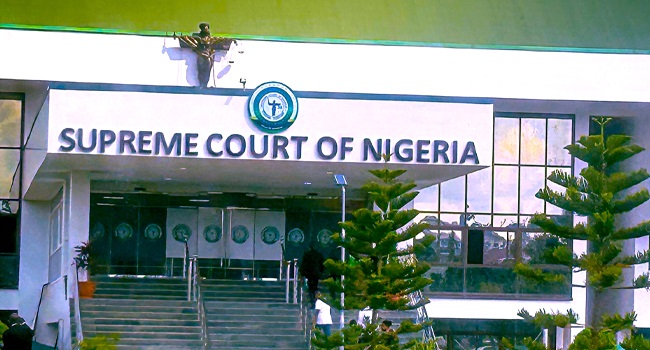
A tense moment reportedly played out at a recent judges’ conference as a Justice of the Supreme Court, Hon. Justice Helen Ogunwumiju, raised strong concerns over the conduct of some courts in the Federal Capital Territory (FCT) in handling political cases, particularly those involving the Peoples Democratic Party (PDP).
According to PDP chieftain, Umar Sani, who disclosed the development during an interview, Justice Ogunwumiju openly expressed “deep disturbance” at what she described as a troubling judicial trend in Abuja.
She reportedly criticised some Federal High Courts for reopening and entertaining political matters that, in her words, had already been conclusively decided by the Supreme Court.
Sources familiar with the discussion said the senior justice warned that such actions undermined the authority of the apex court and weaken the integrity of the judiciary.
She was said to have cautioned that once lower courts begin to revisit settled cases, the certainty of the law is threatened and judicial hierarchy is eroded.
Justice Ogunwumiju reportedly took particular exception to the frequent judicial interventions in the internal affairs of political parties.
She warned that courts risk losing their neutrality when they delve into party disputes that should ordinarily be resolved through internal mechanisms.
“Regardless, you are not supposed to interfere in the internal affairs of a political party.
”Once the court interferes, it becomes an interested party,” she was quoted as saying.
The reported remarks have resonated strongly within the PDP, a party that has been entangled in prolonged leadership and congress-related litigations across several courts.
Many party members believe the avalanche of conflicting court orders has weakened the party’s cohesion and public image.
For some PDP supporters, the Supreme Court justice’s comments have provided a measure of reassurance that concerns about judicial overreach are being acknowledged at the highest level.
They argue that incessant litigation and court injunctions have paralysed party activities and deepened internal divisions.
However, the development has also highlighted what observers describe as a broader crisis within Nigeria’s legal system, where conflicting rulings and jurisdictional overlaps have become increasingly common in political cases.
Legal analysts warned that continued uncertainty could further damage public confidence in the judiciary.
As the controversy unfolds, attention is now firmly fixed on the courts in Abuja.
Many Nigerians are watching closely to see whether the warning from the Supreme Court justice would lead to greater judicial restraint or whether political actors would continue to flood the courts with intra-party disputes, keeping the PDP crisis and judicial controversy alive.