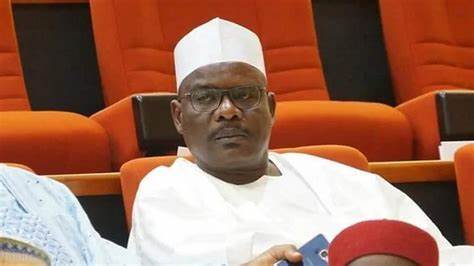
The lawmaker representing Borno South, Ali Ndume, has welcomed the growing military cooperation between Nigeria and the United States, describing it as a timely boost in the country’s protracted battle against insurgency.
Speaking on Friday’s edition of Politics Today, a current affairs programme on Channels Television, Ndume said Nigeria must take full advantage of what he termed a long-awaited opportunity for strategic support.
According to him, successive appeals for advanced assistance had previously yielded little result, but recent developments signal a breakthrough.
“The fact that the Americans are now helping us fight insurgency is a welcome development,” Ndume said.
“We have sought this support for years without success. Now that the opportunity has come, we must utilise it.”
The renewed partnership followed recent statements by the head of the United States Africa Command (AFRICOM), General Dagvin Anderson, who confirmed heightened collaboration between both countries in the area of defence and regional security.
Anderson disclosed that the partnership includes the deployment of a small US team equipped with specialised capabilities to complement Nigeria’s existing counterterrorism efforts.
Although he did not provide operational specifics, reports have suggested that about 200 American troops may currently be on Nigerian soil.
The development has generated debate in some quarters, with critics expressing concern about national sovereignty and the long-term implications of foreign military presence.
Nigeria’s Defence Headquarters (DHQ), however, has moved to allay fears, clarifying that the cooperation centres on capacity building, intelligence sharing, logistics, and professional military education.
The DHQ Director of Defence Information, Major General Samaila Uba, maintained that all engagements are conducted within established bilateral agreements and with full respect for Nigeria’s territorial integrity.
Ndume echoed that position, stressing that US personnel are not participating in frontline combat operations.
“They are not engaging the enemy directly,” he explained. “Their role is largely technological support and training.
”They operate under the leadership and command of the Nigerian Army.”
The renewed security engagement comes amid heightened diplomatic exchanges between both nations.
Last year, U.S. President Donald Trump redesignated Nigeria as a Country of Particular Concern (CPC), citing violence against Christians.
Washington had warned of possible military measures if attacks persisted.
On Christmas Day, the U.S. carried out targeted strikes against terrorist elements in Nigeria, in what both governments later described as a joint operation supported by Nigerian intelligence.
For Ndume, the overriding issue remains the urgency of defeating insurgency, particularly in the North-East, which has endured years of attacks by extremist groups.
“We lack certain critical resources,” the senator said. “If those resources are now being provided — and at no cost — then it is in our interest to make the most of it.”
As security collaboration deepens, the debate is likely to continue over how Nigeria balances foreign assistance with safeguarding its sovereignty — even as the fight against insurgency remains a pressing national priority.