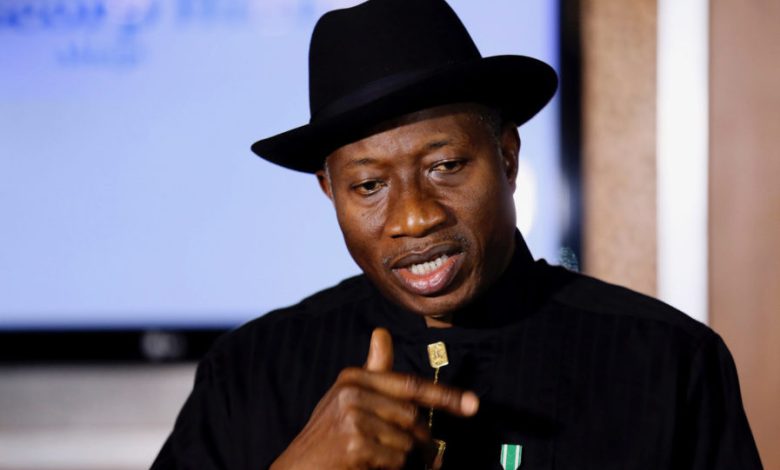
The Office of former President Goodluck Jonathan has issued a clarification regarding recent statements he made on youth involvement in governance, amid repor suggesting he was advocating a maximum age limit for African leaders.
In a statement released on Monday, Ikechukwu Eze, Media Adviser to the former President, addressed what he described as misrepresentations of Jonathan’s comments at the 50th anniversary commemoration of the late General Murtala Mohammed.
Social media discussions had claimed that Jonathan proposed a leadership age cap of 50 years, a characterization Eze firmly rejected.
According to Eze, the former President’s address was intended to highlight the value of youth inclusion in governance rather than prescribe a rigid age ceiling for political office.
“The event commemorated General Murtala Mohammed, who became Head of State at the youthful age of 36.
In reflecting on his legacy, President Jonathan emphasised the vital contributions of young leaders,” Eze stated.
The statement recalled examples cited by Jonathan during his speech, including a 38-year-old Olusegun Obasanjo, a 32-year-old Yakubu Gowon, and a 24-year-old Alfred Diete-Spiff, noting their historical impact as young leaders.
“These references were meant to illustrate how youthful leadership has shaped the nation, not to exclude older individuals from public service,” Eze explained.
The clarification stressed that Jonathan’s central message revolved around competence, innovation, and the ability to meet the demanding responsibilities of public office.
Age, the statement emphasised, should not be the sole criterion for leadership.
“President Jonathan is advocating for generational inclusion and leadership renewal, prioritizing vision, character, and capacity over chronological age,” Eze said.
Eze also pointed out the inconsistency in suggesting an age limit, noting that Jonathan himself ascended to the presidency in his fifties.
“Leadership should be evaluated on the basis of skills, mental and physical capability, and integrity, not age alone,” the statement read.
The media adviser further reiterated that any interpretation suggesting a maximum age of 50 for African leaders misrepresented Jonathan’s intent.
“The examples highlighted by the former President were intended to encourage greater youth participation in governance while maintaining inclusivity across all age groups,” Eze added.
With this clarification, the former President’s office seeks to dispel misunderstandings and reiterate its commitment to promoting leadership based on merit, innovation, and generational collaboration.