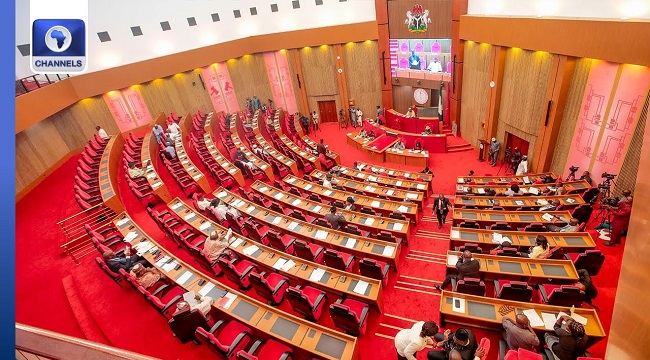
The Nigerian Senate on Tuesday passed the Electoral Act, 2022 (Repeal and Re-Enactment) Bill, 2026, following intense deliberations and a dramatic division over a controversial clause.
Proceedings briefly descended into disorder as lawmakers considered the bill clause by clause after a motion to rescind earlier amendments.
Tension heightened when Senator Enyinnaya Abaribe demanded a division on Clause 60, challenging provisions relating to the transmission of election results.
Senate President Godswill Akpabio initially indicated that the demand had been withdrawn, drawing swift objections from opposition lawmakers.
Deputy Senate President Barau Jibrin cited Senate rules, arguing that revisiting a matter already ruled upon would be procedurally improper.
The chamber erupted in protest, with brief exchanges between lawmakers before order was gradually restored.
Senate Leader Opeyemi Bamidele clarified that he had sponsored the motion for rescission, effectively reopening previously decided provisions for reconsideration.
Abaribe, rising under Order 72(1), pressed for a vote on Clause 60(3), particularly the proviso allowing manual transmission of results if electronic transmission fails.
He argued that Form EC8A should not serve as the sole basis where electronic transmission encounters technical challenges.
During the division, 15 opposition senators voted against retaining the proviso, while 55 lawmakers supported it.
Akpabio subsequently announced that the majority endorsed the clause, paving the way for the bill’s final passage.
Earlier, the Senate dissolved into the Committee of the Whole to reconsider the legislation in detail.
The process was briefly stalled at Clause 60 after Abaribe raised a point of order, prompting consultations and murmurs across the chamber.
The lawmakers later moved into a closed-door session before resuming plenary to conclude deliberations.
Before the rescission motion, senators raised concerns about the timing of the 2027 general elections announced by the Independent National Electoral Commission.
Bamidele explained that the commission had scheduled the elections for February 2027 following consultations with National Assembly leadership.
He noted that the amended law requires elections to be held not later than 360 days before the expiration of tenure.
According to him, strict application of the 360-day notice could result in presidential and National Assembly elections coinciding with Ramadan.
The wmakers warned that conducting polls during the fasting period might affect voter turnout, logistics and overall inclusiveness.
The Senate also identified drafting inconsistencies in several clauses, citing issues with cross-referencing and numbering.
After addressing procedural and substantive concerns, the upper chamber adopted the revised bill, setting the stage for further legislative action.