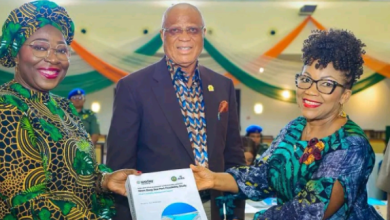
The Federal Government of Nigeria has reiterated its commitment to positioning palm oil as a key driver of the nation’s economic growth and industrial development.
This declaration was made by the Minister of Foreign Affairs, Amb. Yusuf Tuggar, in a statement released on Friday by the ministry’s spokesperson, Kimiebi Ebienfa.
The announcement coincided with the visit of Izzana Salleh, Secretary-General of the Council of Palm Oil Producing Countries (CPOPC), and her delegation to the ministry in Abuja.
Highlighting the historical and contemporary significance of palm oil, Tuggar noted that the commodity has long underpinned industrial expansion in Europe and continues to be critical in sectors such as food production, pharmaceuticals, cosmetics, and manufacturing.
He added that criticisms of palm oil in some international quarters often overlook historical realities, stressing the importance of evidence-based advocacy by producing countries.
“For Nigeria, palm oil is more than an agricultural commodity,” Tuggar emphasized. “It is central to food security, rural livelihoods, and economic diversification.
Currently, our nation produces about 1.4 million metric tonnes annually but consumes around 3 million tonnes. We have ambitious plans to significantly increase production in the coming years.”
Tuggar further explained that Nigeria’s potential full membership in CPOPC represents a strategic step in line with national priorities, including food security, economic growth, and youth employment.
“Joining the Council would amplify Nigeria’s voice in global commodity diplomacy and allow us to benefit from coordinated advocacy, sustainability frameworks, and technical cooperation,” he said.
The Minister warned against letting shifting global consumption patterns or policy narratives weaken Nigeria’s long-term agricultural competitiveness.
Instead, he advocated for forward-looking collaboration with other palm oil-producing nations to secure market access and strengthen collective bargaining power.
During the visit, Salleh described the engagement as both a courtesy call and a substantive policy dialogue aimed at deepening institutional ties between Nigeria and CPOPC.
She commended Nigeria’s proactive stance and reiterated the council’s commitment to supporting the country’s integration into its frameworks.
“Our discussions particularly focused on Nigeria’s transition from observer status to full membership of the intergovernmental body,” Salleh said.
She noted that Nigeria’s current observer status expires at the end of the year and emphasized the importance of early consultations to ensure a smooth transition.
CPOPC, an intergovernmental organization representing major palm oil-producing countries including Indonesia, Malaysia, Papua New Guinea, Honduras, and the Democratic Republic of Congo, does not regulate production quotas like OPEC.
However, it plays a critical diplomatic and advocacy role in addressing trade barriers, regulatory challenges, and sustainability narratives affecting the industry worldwide.
Salleh highlighted the council’s concern over global misconceptions about palm oil, noting that science-based advocacy and coordinated diplomatic engagement are essential to protecting producer interests.
She also disclosed that the council has agreed to waive Nigeria’s membership fees for two years to facilitate rapid integration and strengthen the country’s participation in multilateral advocacy initiatives.
Adding to the discussion, Mr. Tony Lee, Director for Smallholders and Sustainability at CPOPC, outlined the council’s capacity-building initiatives for member states, particularly in Africa.
He emphasised that palm oil accounts for approximately 60 percent of the global vegetable oil supply and plays a vital role in food security, poverty alleviation, and rural development.
He stressed that empowering smallholders through sustainable agricultural practices is key to ensuring long-term resilience in the sector.