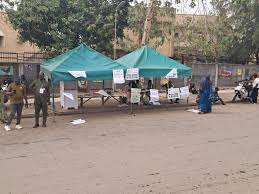
Elections for the chairmanship and councillorship positions in Abuja’s six area councils; Bwari, Kuje, Gwagwalada, Abuja Municipal Area Council (AMAC), Abaji, and Kwali, were conducted on Saturday amid reports of low voter turnout and logistical challenges across many polling units.
The elections, contested by over ten political parties including the African Democratic Congress (ADC), Zenith Labour Party (ZLP), Labour Party (LP), All Peoples Congress (APC), All Progressive Grand Alliance (APGA), and Young Peoples Party (YPP), were generally peaceful, though several polling units in both the city centre and satellite towns experienced delays in the start of voting.
While the Independent National Electoral Commission (INEC) had targeted 8:00 a.m. for the commencement of voting, officials at many centres arrived late.
At Kogo Primary School, which hosts polling units 28, 29, and 30, officials reportedly arrived at 8:10 a.m. and only began voting at 8:30 a.m.
In Lugbe, polling units 064 and 008 saw similar delays, with observers noting that party agents and voters had arrived by 7:00 a.m., yet voting started much later.
In other units such as Daki Biyu Village II (44 Junction), Jabi, INEC officials were still preparing at 9:04 a.m., with no voters in sight.
Even at PU 114, Aguiyi Ironsi Street, Wuse, officials were observed setting up as late as 10:35 a.m., with party agents outnumbering potential voters.
Despite these setbacks, some polling units managed to open relatively on time.
PU 008, Government Secondary School in Zone 3, began accreditation at 9:01 a.m., while PU 007, Security Post on Sultan Abubakar Way, was fully operational by 8:50 a.m., though several voters reported missing names from the register.
In satellite towns such as Karu and Ketti, turnout was slightly better, though still below expectations. At Karu’s EC 34 polling unit, only 30 of 407 registered voters had cast ballots by 2:30 p.m., demonstrating persistent voter apathy.
Observers attributed the low participation to doubts over electoral credibility, logistical delays, and general disengagement from the process.
INEC Chairman Joash Amupitan, who monitored the exercise across AMAC, Bwari, and Gwagwalada, commended the use of the Bimodal Voter Accreditation System (BVAS), noting that voter accreditation often took less than five seconds per voter.
He confirmed that about 99 per cent of polling units were operational by 10:30 a.m. and expressed confidence that the elections would conclude successfully despite minor delays.
“The election is orderly, efficient, and peaceful,” Amupitan said. “Sensitive materials were deployed early, and officials were on ground across the FCT.
”Feedback from Assistant Presiding Officers indicates that the accreditation process using BVAS is fast and reliable, strengthening the credibility of the exercise.”
FCT Minister Nyesom Wike, who also visited multiple polling units including Wassa, Ketti, Karshi, and Karu, acknowledged the generally peaceful conduct but noted low participation in the city centre.
He praised security personnel for ensuring order and emphasized that no violence or destruction of election materials occurred.
Wike also addressed criticism from Senator Ireti Kingibe regarding a restriction on movement from 8 p.m. Friday to 6 p.m. Saturday, clarifying that the restriction was authorised by President Bola Tinubu and was not a curfew.
In contrast, the ADC condemned Wike’s presence at polling units during voting, describing it as “interference” that could intimidate voters.
Party spokesperson Mallam Bolaji Abdullahi also raised concerns about the INEC Result Viewing Portal (IReV), which reportedly failed to display results even as collation proceeded.
The Obedient Movement, aligned with former presidential candidate Peter Obi, echoed these concerns, warning that IReV disruptions risked undermining transparency.
Former Kaduna Senator Shehu Sani and AAC candidate Omoleye Sowore linked low turnout to voter disinterest and diminishing trust in the electoral process.
Sowore specifically cited the recently signed Electoral Act Amendment Bill as a factor that reduced confidence, arguing that many Nigerians no longer see voting as effective or worthwhile.
Despite these challenges, observers, party agents, and electoral officials reported an overall peaceful and orderly election, with counting and collation underway at several polling units.