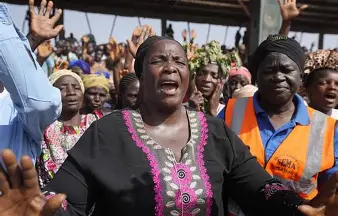
Africa hosts one of the world’s fastest-growing Christian populations, rising from about 10 million in the early 1900s to roughly 750 million today, nearly half the continent’s population.
Yet analysts warn that this expansion now faces a serious security challenge amid persistent extremist violence in several regions.
A report by the International Society for Civil Liberties and Rule of Law says Christians in parts of Africa are experiencing increasing attacks and insecurity.
The report highlights Nigeria, the Democratic Republic of the Congo and Ethiopia, countries that together account for an estimated 300 million Christians.
In Nigeria, armed groups including Fulani militias, Boko Haram and Islamic State West Africa Province have sustained violent campaigns for more than a decade.
Attacks have frequently targeted villages, worship centres and schools, particularly in rural communities.
In eastern Congo, the Allied Democratic Forces has been linked to deadly assaults on civilians.
Across parts of East Africa, Al-Shabaab continues cross-border operations, compounding regional insecurity.
The humanitarian toll includes killings, abductions, displacement and destruction of homes and community infrastructure.
According to the 2026 World Watch List by Open Doors, hundreds of millions of Christians worldwide face high levels of persecution, with Africa emerging as a significant hotspot.
Observers caution that insecurity is compounded by weak governance, porous borders, poverty and longstanding communal tensions.
They add that extremist violence does not spare moderate Muslims or adherents of traditional beliefs.
Recent incidents in Kwara State, Nigeria, illustrate how entire communities suffer when law enforcement systems fail.
While threats facing Christians, particularly in Nigeria’s Middle Belt, remain serious, experts warn against framing the crisis solely as a demographic struggle.
Analysts argue that such narratives risk deepening divisions rather than fostering durable solutions.
They advocate coordinated responses, including stronger security institutions, accountable governance, interfaith dialogue and expanded economic opportunities for vulnerable youths.
Ultimately, the future of Christianity in Africa, like that of Islam and other faiths, may depend less on population growth and more on governments’ ability to secure lives and uphold justice.
The broader test, they contend, is whether pluralism and peaceful coexistence can endure across the continent.