The Dangote Group has announced ambitious plans to expand into steel production, electricity generation, and port development as part of its drive to accelerate industrialisation across Africa.
The announcement coincides with the induction of 330 graduate engineers into the Dangote Petroleum Refinery and Petrochemicals workforce, reinforcing the company’s commitment to nurturing local talent and strengthening Nigeria’s engineering capacity.
The conglomerate, led by billionaire industrialist Aliko Dangote, currently spans cement, sugar, salt, fertiliser, and petrochemicals.
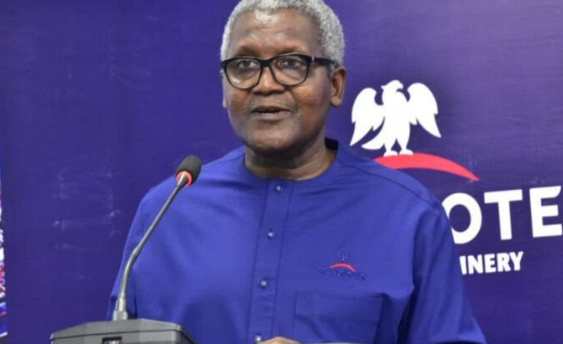
Speaking on the company’s growth strategy, Dangote highlighted the long-term vision to deepen Africa’s manufacturing base beyond oil refining, positioning the continent as a global industrial powerhouse.
“The refinery is only one stage of our broader plan,” Dangote told The New York Times, according to a statement by Dangote Group.
“We have to industrialise Africa. Our next focus will include steel, expanding access to electricity, and developing additional port infrastructure to support large-scale manufacturing and trade.”
The Dangote Petroleum Refinery & Petrochemicals, operational for over two years, currently processes 650,000 barrels per day of crude into a variety of petroleum products.
Dangote said production is expected to double within the next three years as expansion plans advance.
Analysts noted that venturing into steel will give the group a foothold in a sector critical to infrastructure, housing, and heavy industry, while investments in power and port facilities could help overcome two of Nigeria’s most persistent constraints to economic growth.
Dangote cited India’s Tata Group as a model for diversified industrial expansion, demonstrating how multi-sector operations can transform emerging economies.
He stressed that job creation remains central to his strategy, noting that Nigeria is projected to require between 40 and 50 million new jobs by 2030. “Large-scale industrial projects are essential to absorb the growing youth population,” he said.
Currently, the refinery employs around 30,000 workers, 80 percent of whom are Nigerians. Expansion into new sectors is expected to raise total employment within the Dangote Group to roughly 65,000.
The company also plans to list shares of the refinery on the Nigerian stock market to broaden local participation, though Dangote acknowledged ongoing challenges with logistics and crude supply.
Meanwhile, the refinery formally inducted 330 graduate engineers into its technical workforce.
The induction, held at the refinery complex, welcomed engineers from top tertiary institutions across Nigeria, integrating them into a structured program combining technical mentorship, rotational exposure, and hands-on training.
Addressing the graduates, CEO David Bird described the induction as a milestone in the company’s human capital development.
“This initiative is designed to strengthen Nigeria’s engineering talent pool and ensure operational excellence across our integrated energy infrastructure,” he said, urging the engineers to pursue innovation, commitment, and excellence in their work.
The trainees, specialising in Chemical, Electrical, Mechanical, and Instrumentation Engineering, completed classroom sessions, project presentations, and practical assessments aimed at solving operational challenges within the refinery.
Dr. Ebele Oputa, Assistant General Manager for Human Asset Management and programme coordinator, noted that the training bridges academic theory with practical experience, while also nurturing leadership skills among the young engineers.
“The programme follows a structured pathway including induction, observation, shadowing, classroom and hands-on equipment training, and supervised work at plant units,” Oputa explained.
“This approach prepares them to meet workplace challenges confidently while developing the leadership capabilities necessary for future roles.”
With cement plants across Africa and a refinery reshaping Nigeria’s downstream sector, Dangote’s new focus on steel, power, and port infrastructure signals the next chapter in the industrialisation of the continent.