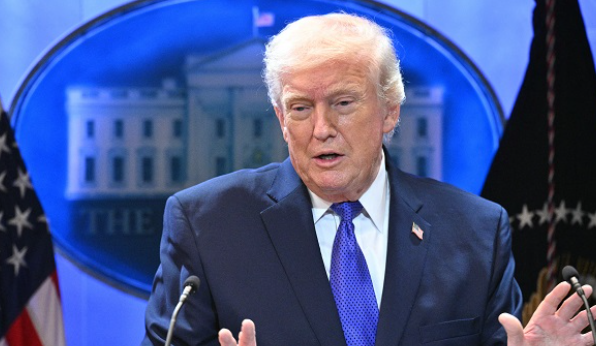
U.S. President Donald Trump on Thursday declared that he must play a role in the selection of Iran’s next supreme leader following the death of Ayatollah Ali Khamenei.
Trump described Khamenei’s son, Mojtaba Khamenei, as “unacceptable” and indicated that a US-influenced choice would help bring stability and peace to the country.
Speaking in an interview with Axios, Trump drew a comparison with Venezuela, pointing to interim president Delcy Rodriguez, who has cooperated with him under the threat of U.S. intervention after the removal of Nicolás Maduro.
Trump emphasised that the United States risks entering another conflict within five years unless Iran has leadership favorable to US interests.
Trump’s remarks suggest a willingness to work with Iranian insiders rather than seeking to overthrow the government, which has been a longstanding adversary of the US since the 1979 revolution that ousted the pro-Western Shah.
He mentioned the late Shah’s son, Reza Pahlavi, who has proposed returning as a transitional leader to oversee a shift toward secular democracy.
The selection of Iran’s supreme leader is traditionally the prerogative of an assembly of senior Shiite clerics, most of whom are staunchly opposed to U.S. influence.
Trump’s insistence on being involved raised questions about the feasibility of such interference, given Iran’s established religious and political protocols.
The late Ayatollah Ali Khamenei, who had ruled Iran since 1989 with a hardline domestic and foreign policy, was killed in an Israeli strike over the weekend amid escalating tensions between Israel and the US in the region.
His son, Mojtaba Khamenei, is now considered a potential contender for succession.
Trump highlighted that, unlike backing long-standing opposition groups favored by the U.S., working with figures like Delcy Rodriguez in Venezuela has proven effective in advancing US objectives.
He underlined that Rodriguez, although Maduro’s former vice president, cooperated under US pressure to secure strategic resources, including oil.
The president noted that any new leadership in Iran must prioritise harmony and peace while remaining open to constructive engagement with the United States, implying that he sees an opportunity to shape Iran’s political future from within rather than through external regime change.