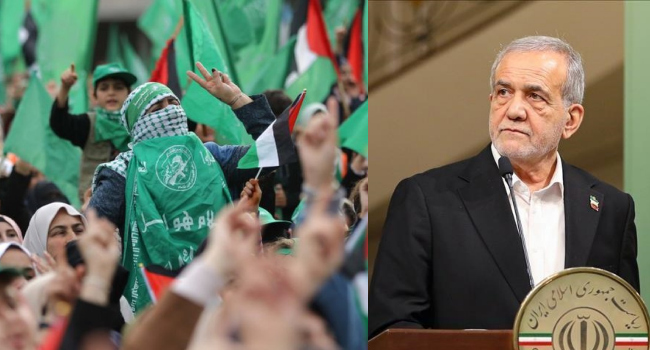
The Palestinian Islamist group Hamas has appealed to Iran to avoid launching attacks against neighbouring countries as tensions in the Middle East continue to escalate.
In a statement issued on Saturday, the group acknowledged Iran’s right to defend itself but urged restraint to prevent the conflict from spreading further across the region.
Hamas said while it supports Tehran’s right to respond to what it described as aggression from Israel and the United States, such responses should not involve strikes on nearby nations.
The organisation stressed that actions targeting neighbouring countries could widen the crisis and further destabilise the region.
The appeal comes as the conflict, which began after military strikes late last month, approaches its third week.
The growing tensions have already triggered economic uncertainty around the world, particularly in global energy markets.
Global oil prices have continued to climb amid fears that the ongoing hostilities could disrupt supply.
Brent crude, the international benchmark for oil prices, remained above $100 per barrel on Friday despite temporary fluctuations during the day.
Financial markets have reacted nervously to the situation.
Stock markets declined in several regions as investors expressed concern that a prolonged war could fuel inflation and slow economic growth worldwide.
Analysts said energy prices were currently driving movements across global markets.
Market analyst Fawad Razaqzada noted that traders are struggling to determine a stable price for crude oil due to the ongoing uncertainty surrounding the conflict.
He explained that while governments have released emergency oil reserves and eased certain restrictions on Russian oil shipments, those measures have not been enough to calm markets.
The situation worsened after Iran reportedly closed the Strait of Hormuz, a strategic waterway through which roughly one-fifth of the world’s crude oil and liquefied natural gas supplies pass.
The move has intensified fears of a global energy crisis, as disruptions in this vital shipping route could significantly reduce supply and push prices even higher.
Market experts warned that rising energy costs may trigger broader inflation across economies.
Joshua Mahony, chief market analyst at Scope Markets, said investors remained deeply concerned about the growing risk of an energy-driven inflation surge.
The economic uncertainty is also complicating the outlook for global monetary policy.
Before the conflict escalated, many analysts expected major central banks to cut interest rates this year to support economic growth.
However, surging energy prices are now forcing policymakers to reconsider their plans.
Several central banks, including the Federal Reserve and the Bank of England, are scheduled to hold interest-rate meetings next week.
Investors will be watching closely for signals on whether policymakers will maintain current rates or tighten monetary policy to counter rising inflation.
Meanwhile, economic data from the United States has added to market uncertainty.
Recent figures showed that U.S. economic growth in the fourth quarter was revised downward to 0.7 per cent, while inflation remains above the Federal Reserve’s two-percent target.
As tensions continue in the Middle East, analysts warn that prolonged instability could further disrupt global markets, drive energy costs higher, and place additional pressure on economies around the world.