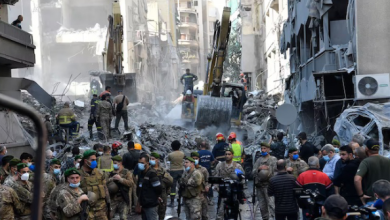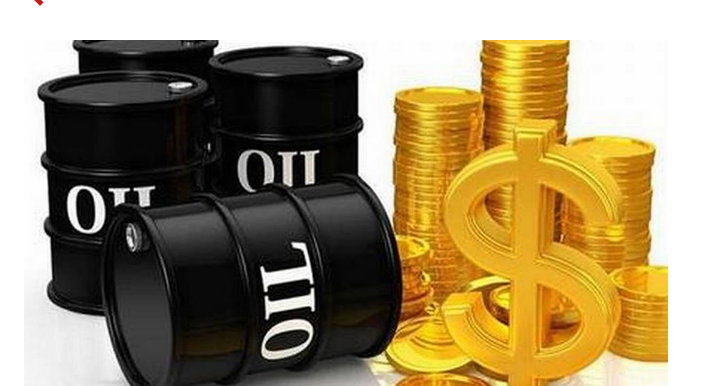
Brent crude surged over 5 per cent to more than $110 a barrel on Wednesday following an Israeli strike on Iran’s massive South Pars gas field, conducted in coordination with the United States.
The attack represents the first direct targeting of Iran’s upstream oil and gas infrastructure since the war erupted on February 28, as the conflict entered its 19th day.
The South Pars gas field, shared with Qatar, supplies roughly a fifth of the world’s liquefied natural gas (LNG).
Qatar condemned the strikes as “a dangerous and irresponsible step,” while Tehran retaliated with threats to target energy facilities across Saudi Arabia, the UAE, and Qatar, including the Samref refinery, Jubail petrochemical complex, and Al Hosn gas field.
Iran’s military stated it would escalate operations “in new ways.”
Global oil markets have already been under strain, with Brent crude up roughly 80 per cent since the conflict began.
The shutdown of tanker traffic through the Strait of Hormuz, a chokepoint handling about 20 per cent of global oil flows, has exacerbated the crisis.
Despite emergency oil releases by the International Energy Agency and the U.S. Strategic Petroleum Reserve, prices remain elevated.
WTI crude in the U.S. trades around $96, while Dubai and Oman benchmarks have soared above $150 per barrel, signaling extreme scarcity in Asia.
Meanwhile, QatarEnergy reported damage at the Ras Laffan industrial complex after a missile attack attributed to Iran.
Authorities confirmed preliminary control of fires, with no casualties reported.
The Iranian strike came in retaliation for U.S.-Israeli attacks on Iranian gas facilities at South Pars.
Saudi Arabia also intercepted ballistic missiles and drones targeting energy infrastructure.
The conflict intensified further as Iran’s Intelligence Minister Esmaeil Khatib was killed in an Israeli airstrike in Tehran, joining a series of high-profile assassinations including Ali Larijani and the head of the IRGC’s Basij paramilitary.
Iranian President Masoud Pezeshkian condemned the attack, calling it a “cowardly assassination,” while Israel’s defence minister Israel Katz confirmed the operation, citing Khatib’s role in supporting Iran’s “repression and terrorist activities.”
In response to Iranian missile strikes, Qatar expelled Iran’s defence ministry representative from its embassy, declaring the envoy persona non grata.
The Gulf state reaffirmed its right to self-defence under Article 51 of the UN Charter, emphasising its commitment to protecting national sovereignty.
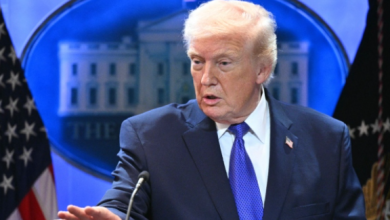
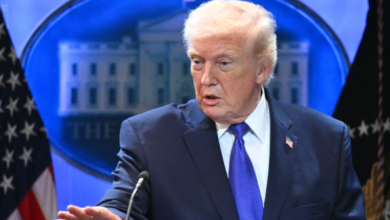
U.S. President Donald Trump weighed in on social media, suggesting the U.S. might “finish off” what remains of the “Iranian Terror State,” leaving responsibility for the Strait of Hormuz to regional users.
British and U.S. military officials are reportedly exploring options to reopen the strategically vital waterway, though high risk and Iran’s expanded arsenal—including mines, fast attack boats, drones, and ballistic missiles—complicate any intervention.
Defence Secretary John Healey highlighted ongoing coordination with European allies, warning that the situation remains “incredibly fluid.”
The attacks and ensuing escalation have sent global energy prices skyrocketing, with analysts warning that prolonged disruption of the Strait of Hormuz could have severe economic repercussions worldwide.