At a time of global energy disruptions triggered by the ongoing U.S.-Israel conflict with Iran, Nigeria is steadily reasserting itself as a reliable supplier of crude oil and gas, the Nigerian National Petroleum Company Limited (NNPC) said on Tuesday.
NNPCL attributed the country’s improving global standing to enhanced security in the Niger Delta and a more stable policy environment, even as the U.S.-Israel war has disrupted oil production in the Middle East and closed the Strait of Hormuz, a crucial passage for around 20 percent of global oil supply.
The national oil company projected a moderate rise in crude output over the coming months, anticipating an increase of about 100,000 barrels per day, though this remains below Nigeria’s 2026 budget benchmark of 1.84 million barrels per day.
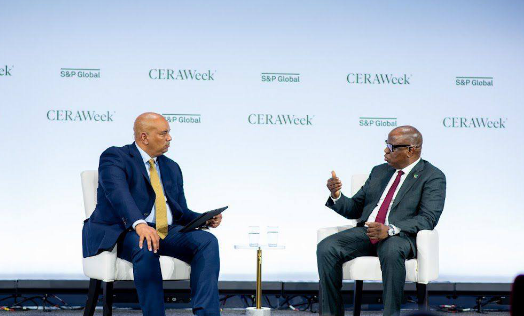
Group Chief Executive Officer (GCEO) of NNPCL, Mr. Bayo Ojulari, shared the disclosures during a Fireside Chat at CERAWeek 2026 on Tuesday in Houston, hosted by S&P Global under the theme, “Convergence and Competition: Energy, Technology and Geopolitics.”
During the session, anchored by S&P Global Senior Vice President Daniel Pratt, Ojulari told international investors and stakeholders that the NNPCL was prioritising project execution discipline, which he described as key to defining the company’s success over the next five to 10 years.
Ojulari credited President Bola Tinubu for granting NNPC enhanced operational autonomy, enabling the company to make commercially driven decisions, strengthen efficiency, and improve overall sector performance.
He praised the Dangote Refinery for reducing Nigeria’s vulnerability to global supply volatility, saying the plant has bolstered domestic refining capacity and energy security.
“The refinery has achieved its nameplate capacity, providing a guaranteed destination for crude and a robust domestic supply network,” he added.
Highlighting the Petroleum Industry Act (PIA) 2021, Ojulari said the law transformed NNPC into a commercially competitive entity, allowing it to compete alongside private firms and attract investment.
He noted that NNPC had completed a full portfolio review last year and had begun implementing reforms to strengthen partnerships with international oil companies, including ExxonMobil, Chevron, Shell, TotalEnergies, and ENI.
Ojulari cited recent progress in clearing long-standing project bottlenecks, referencing the ENI-operated OPL245 and Shell’s Bonga Southwest projects, as evidence of growing investor confidence in Nigeria’s energy sector.
He outlined plans to commission NLNG Train7 before the end of 2026 to boost gas exports and domestic supply, with future expansion to Trains 8 and 9 under consideration.
“Nigeria is essentially a gas country. Our goal is to transform the sector to meet domestic demand, power generation, industrialisation, and export requirements,” Ojulari said.
The GCEO also highlighted critical infrastructure projects, including the Ajaokuta-Kaduna-Kano (AKK) pipeline, the Obiafu–Oben–Obrikom (OB3) pipeline, and LNG capacity expansion, describing these as essential for optimising Nigeria’s gas resources.
Regarding production forecasts, Ojulari acknowledged the country’s historical underperformance relative to its 1.84 million bpd fiscal benchmark, citing shortfalls in January and February 2026 that left a cumulative deficit of about 16.6 million barrels.
Nevertheless, he stressed that NNPC was steadily building capacity and contributing to mitigating the global oil supply shock caused by the Middle East crisis.
Ojulari emphasised that disciplined project execution and commercial rigor remain central to unlocking Nigeria’s energy potential.
“We have the resources, we have the markets, and we’ve built an investable environment. The point now is to prove it,” he said.
He identified deepwater projects as a strategic priority due to scale advantages, lower onshore risks, and potential to attract global investment.
Top Nigerian delegates attending the CERAWeek event included Mr. Saidu Mohammed (NMDPRA), Mr. Austin Avuru (AA Holdings), Mr. Osagie Okunbor (former Shell Nigeria MD), Abdulrazak Isa (Waltersmith), Mr. Roger Brown (Seplat), and other senior NNPC and industry executives.
CERAWeek 2026, running March 23–27 in Houston, brings together over 10,000 energy leaders, executives, and policymakers to discuss the intersection of energy, technology, and geopolitics.