The federal government has intensified efforts to transform Nigeria’s education sector, unveiling major reform gains alongside a bold financing strategy, including plans to secure an additional $500 million from a proposed $11.5 billion global education fund.
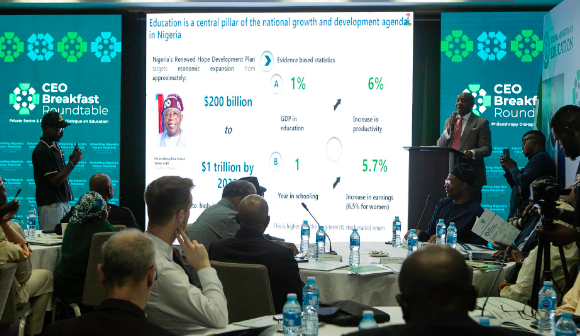
The Minister of Education, Dr. Tunji Alausa, disclosed the development on Tuesday during the Federal Ministry of Education (FME) and Global Partnership for Education (GPE) CEO Breakfast Meeting in Lagos, which convened top private sector leaders and development partners to align investments with the government’s reform agenda.
Alausa said the global replenishment initiative, which seeks to raise $11.5 billion to support foundational learning across 80 countries, presents a unique opportunity for Nigeria to deepen ongoing reforms.
“If everything goes well, Nigeria stands to benefit from another $500 million to support foundational education,” he noted.
The minister emphasised that education remains the most strategic investment for national growth, citing evidence that increased spending drives productivity.
“For every one per cent increase in education spending, productivity rises by six per cent.
”Each additional year of schooling leads to about a 5.7 per cent increase in earnings, with even greater impact for women,” he explained.
Providing a progress report, Alausa revealed that over 1.1 million out-of-school children had been reintegrated into classrooms within the past year, marking a significant milestone.
“In the last 24 months, we’ve moved well over 1.1 million children from the streets back to school,” he said.
He however, acknowledged that Nigeria still faced a deep-rooted education crisis, with roughly 15 million children out of school, concentrated primarily in the North-east and North-west.
Alausa further highlighted the alarming rate of learning poverty, noting that millions of children are unable to read age-appropriate texts by the age of 10.
He also drew attention to the sharp drop in enrolment from primary to junior secondary school, largely due to inadequate infrastructure.
“Today, we have about 32 million children in primary schools, but only around six million continue to junior secondary school, a drop-off of nearly 22 million,” he said.
The minister attributed the disparity to the limited number of junior secondary schools nationwide.
“There are about 78,000 primary schools but only 9,000 junior secondary schools. Access is clearly a major challenge,” he stated.
”To address infrastructure deficits and improve learning conditions, the federal government has earmarked N100 billion for the construction of new student hostels across universities and polytechnics.
“This year, we will invest about N100 billion in building hostels to expand access and enhance learning environments,” Alausa said.
He added that investments were also being channelled into rehabilitating engineering workshops, medical schools, and technical institutions, with a particular focus on STEM and technical education.
“We are investing heavily in STEM and technical education because that is where the future lies,” he noted.
On basic education financing, the minister reported significant progress in enabling state governments to access Universal Basic Education Commission (UBEC) matching grants.
“Before our reforms, nearly N240 billion in grants went unaccessed.
”Today, over N140 billion has been accessed and deployed by states to build classrooms, provide furniture, and improve sanitation,” he said.
Alausa also revealed plans to increase UBEC funding from two per cent to four per cent through legislation currently before the National Assembly.
Highlighting the use of technology, he disclosed that the ministry has launched a nationwide digital platform to track students throughout their educational journey.
“For the first time, we can monitor every child from primary school onward, identify dropouts, and intervene where necessary.
”This is a game-changer for data-driven policymaking and accountability,” he said.
Alausa said new fiscal measures, including a development levy, were being implemented to increase education funding, with a significant portion earmarked for key agencies.
He also highlighted progress in student financing, noting that over one million students have benefited from government-backed education loans.
“We are building a system that is transparent, accountable, and results-driven, but we need collective action to achieve lasting impact.”
Earlier, the Minister of State for Education, Professor Suwaiba Said Ahmad, underscored the importance of private sector collaboration in driving large-scale transformation.
“Education is the cornerstone of national progress. No nation can achieve sustainable growth without a strong, inclusive, and forward-looking education system,” she said.
Ahmad explained that the breakfast meeting was designed to move beyond dialogue, fostering actionable partnerships with the private sector and development partners.
“This platform encourages innovative solutions that will accelerate transformation across all levels of education,” she added.
“The private sector remains a critical partner in driving innovation, expanding infrastructure, and ensuring that our education system produces globally competitive graduates,” Ahmad said.
Both ministers emphasised that sustainable financing is central to the success of the Nigeria Education Sector Renewal Initiative (NESRI), aligned with President Bola Ahmed Tinubu’s Renewed Hope Agenda.
Despite these gains, the ministers stressed that government resources alone cannot meet the scale of investment required.