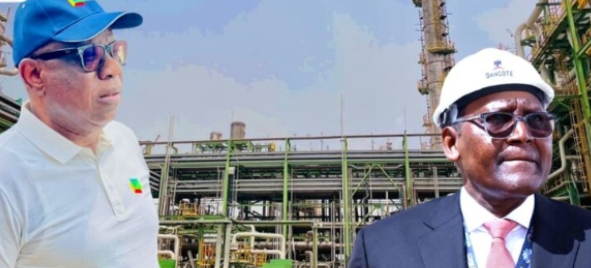
The Group Chief Executive Officer of Nigerian National Petroleum Company Limited, Bayo Ojulari, says the company’s collaboration with the Dangote Refinery is playing a key role in stabilising Nigeria’s fuel supply.
Ojulari made this known while speaking on the sidelines of the CERAWeek by S&P Global conference in Houston, United States, where he highlighted the impact of the partnership on the country’s energy sector.
He explained that NNPC Limited holds a 7.25 per cent equity stake in the Dangote Refinery, a relationship he said has strengthened cooperation in crude oil supply and improved the distribution of refined products nationwide.
According to him, the synergy between both entities has contributed significantly to the improved availability of petroleum products across Nigeria.
Beyond refining, Ojulari pointed to ongoing efforts to expand gas infrastructure, particularly the Ajaokuta–Kaduna–Kano (AKK) pipeline project.
He said the initiative is expected to boost gas supply to northern parts of the country, stimulate industrial growth, and enhance electricity generation.
He noted that gas development has already driven the emergence of industrial clusters in parts of the South-East and South-West, adding that similar benefits are expected in the North once the pipeline is completed.
The NNPC boss further stressed that the company is undergoing transformation under the Petroleum Industry Act (PIA), with a focus on improving performance and institutional culture.
He said the goal is to reposition NNPC as a globally competitive energy company, comparable to leading firms such as Saudi Aramco, Petronas, and Petrobras.
Ojulari emphasised that achieving this objective would require cooperation from all stakeholders, including government institutions and the general public, as the company transitions into a fully commercial entity.
On recent policy developments, he expressed support for Executive Order 9 signed by President Bola Tinubu, which aims to enhance cost efficiency and transparency in upstream petroleum operations.
While acknowledging concerns raised by groups such as the Petroleum and Natural Gas Senior Staff Association of Nigeria (PENGASSAN), Ojulari said the intent of the policy is to improve revenue accountability across the sector.
He added that NNPC is actively working with implementation teams to ensure the policy achieves its objectives, noting that technical inputs are being provided to support a smooth rollout.
The remarks underscore ongoing efforts by the government and industry players to strengthen Nigeria’s energy security and ensure a more stable and efficient fuel supply system.