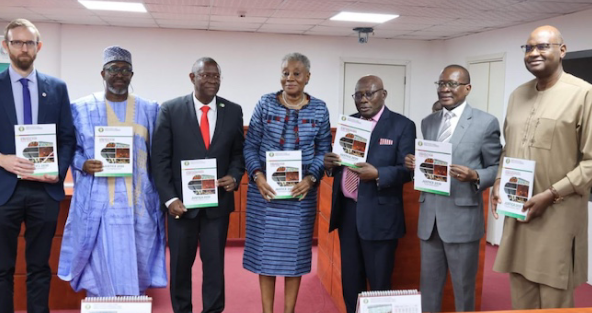
The ECOWAS Court of Justice has launched a five-year strategic plan aimed at reinforcing the rule of law, widening access to justice, and deepening regional integration across West Africa.
The plan, spanning 2026 to 2030, was unveiled in Abuja, where court leadership outlined a vision to transform the institution into a more effective and accessible pillar of justice within the Economic Community of West African States (ECOWAS).
Court President Ricardo Goncalves described the initiative as a turning point for the institution, signaling a renewed commitment to safeguarding justice and promoting stability in the region.
“This moment is not merely symbolic. It represents a clear affirmation of our collective resolve to strengthen the role of the Court as a guarantor of the rule of law and a promoter of justice,” Goncalves said.
The strategy prioritised institutional transformation, operational efficiency, and measurable impact on citizens throughout ECOWAS member states.
Goncalves stressed that achieving these objectives requires close collaboration among judges, administrative staff, and regional stakeholders.
He urged judges to ensure the quality and consistency of judicial decisions while promoting a justice system that is accessible, timely, and widely respected.
Administrative staff, he noted, play a critical role in case management, technical excellence, and overall efficiency.
The court president also highlighted the need for stronger partnerships with member states, legal practitioners, development partners, and civil society organisations to enhance enforcement of court judgments and encourage legal harmonisation across the region.
In her remarks, Deputy Registrar Marie Saine described the plan as a renewed commitment to justice and service, emphasising that it was developed through extensive consultations and institutional review.
She noted that the strategy focused on key priorities, including timely and impartial justice, expanded access to legal services, strengthened human rights protection, increased transparency, and improved institutional capacity.
According to Saine, the roadmap provides clear guidance for the court’s work over the next five years while addressing emerging legal and governance challenges in West Africa.
The ECOWAS Court of Justice, the judicial arm of the regional bloc, is mandated to interpret community law, protect human rights, and resolve disputes involving member states and institutions.
Officials said the new framework replaces the court’s previous plan and is designed to position the institution to respond more effectively to evolving legal demands while bolstering its contribution to peace, justice, and integration in the region.