Former President Goodluck Jonathan has called for a deliberate alignment between democratic governance and sound economic policies to ensure the long-term sustainability of Nigeria’s political system.
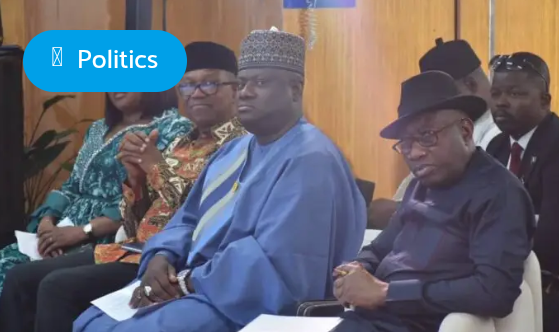
Jonathan made the call on Thursday in Abuja at the national convening and launch of a research report by the Goodluck Jonathan Foundation.
The report, titled “Strengthening the Nexus between Democracy and Economic Growth in Nigeria,” highlights the need for stronger connections between governance and economic performance.
The former president urged policymakers to move beyond the conduct of elections and focus on building transparent and accountable institutions capable of fostering innovation and enterprise.
He noted that the event was taking place at a critical time when democracies around the world are facing increasing pressure from economic hardship, insecurity, social tensions and declining trust in public institutions.
Reflecting on global governance systems, Jonathan observed that some non-democratic nations have recorded significant development, but stressed that democracy remains unique because it guarantees freedom.
“Sometimes when I look at the topics, I ask myself, can we really say that democracy will lead to better governance than other forms of government like we see in the Arab world, the monarchies?
“Most of you go to Dubai, the centre of the world. I know of some American friends that send their children to go and school in Dubai and it’s not a democracy there,” he said.
He also pointed to countries like China, where governance systems differ from liberal democracy, noting that their leadership recruitment processes emphasise merit and rigorous selection.
“In China, they combine selection and election; so before you become a mayor of any of their cities, you are filtered and you are one of the best.
“Can we truly say that our democracy is close to that?” he queried.
Despite these comparisons, Jonathan emphasised that freedom and justice remain the defining pillars of democracy, noting that citizens must be able to express themselves and associate freely without fear.
“When these two elements have been taken away from democracy, then, of course, it’s no longer a democratic state,” he said.
He warned that democracies that fail to deliver economic progress risk losing legitimacy, describing the gap between governance and economic outcomes as one that must be urgently addressed.
“Our country is not immune to these trends. Nigeria’s journey offers both lessons and opportunities. Our democracy has endured, but endurance alone is not enough.
“Effective policies that promote economic growth are crucial to making our democracy more sustainable,” he said.
Jonathan stressed that Nigeria must not treat democracy and development as separate goals, but rather as mutually reinforcing objectives.
“A strong democracy should create conditions for economic growth, and inclusive economic growth should, in turn, deepen and sustain democracy.
“History will not judge us merely by the systems we uphold, but by the outcomes we deliver,” he added.
He explained that his foundation’s “Democracy Dialogue” initiative aims to support governance by bringing together experts from across Africa to discuss development-focused issues.
Jonathan commended contributors to the report and urged policymakers, civil society organisations and the private sector to act on its recommendations with urgency.
He said such collective efforts would help build a Nigeria where democracy translates into real opportunities, prosperity and justice for all citizens.