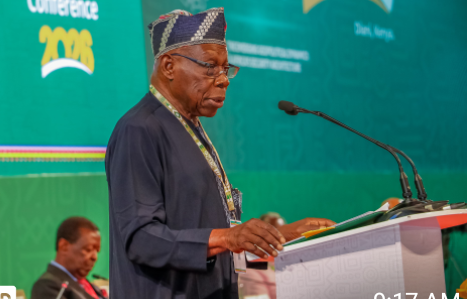
Former Nigerian President Olusegun Obasanjo has issued a strong warning over the dangers of poor intelligence interpretation.
He said, “misinterpretation and misapplication of intelligence is always disastrous,” while pointing to Iraq, Sierra Leone, and possible misjudgements about Iran as key examples.
Speaking at the Mashariki Cooperation Conference III, hosted by Kenya’s National Intelligence Service in Diani, Obasanjo criticised the way intelligence was often analysed and acted upon.
He argued that many failures were not due to lack of information but poor political judgement.
He said the Sierra Leone civil war illustrated this clearly, stressing that mediators and decision-makers repeatedly failed to understand the true nature of the Revolutionary United Front (RUF).
He described the RUF as a criminal network that used revolutionary rhetoric to justify extreme violence, including mutilation, abductions, and widespread terror against civilians.
“They used power for impunity and recklessness,” he said, adding that the conflict exposed deep weaknesses in political interpretation of intelligence.
The former president, who has played a role in mediating conflicts across Burundi, the Democratic Republic of Congo, Zimbabwe, and Sudan, said intelligence is vital to preventing conflict but remains “woefully underused” in that role.
He noted that in many crises, warning signs were visible long before violence erupted, including rising ethnic tensions, recruitment of armed youth, and regional interference.
“The information existed. What was missing was the institutional will to act on it, to share it across borders, and to take the political risks that early intervention requires, ” he said.
Obasanjo also raised concerns about global threat assessments, making a pointed reference to Iran while contrasting it with the intelligence failures that led to the Iraq war.
“Is Iran a true, genuine and serious threat to the U.S.?
”I leave that to you,” he told participants, adding, “We saw it in Iraq.”
He urged African intelligence agencies to strengthen early warning systems and prioritise preventive action.
According to him, intelligence services must become more focused on early detection of crises and more willing to act collaboratively across borders.
“The failure of intelligence can be a disaster for the giver, the receiver, and beyond,” he warned.
The gathering brought together more than 80 intelligence chiefs from Africa, the Caribbean, and other regions.
The conference is part of ongoing efforts to review Africa’s evolving security landscape and strengthen cooperation among intelligence agencies.
Discussions focused on regional security architecture, counterterrorism strategies, geopolitical shifts, and the impact of climate change and emerging technologies on stability.
Organisers said the forum aimed to integrate African perspectives into global security discussions while promoting stronger regional partnerships.
The 2026 edition marks the third iteration of the conference, which continues to explore ways to improve intelligence sharing and collective security across the continent.