Astronauts aboard Artemis II successfully returned to Earth on Sunday, April 11, 2026, after completing a historic journey around the Moon, marking the first crewed mission to the lunar vicinity in more than 50 years.
The NASA crew of four splashed down in the Pacific Ocean after nearly 10 days in space, concluding a mission widely described as a major milestone toward future lunar landings.
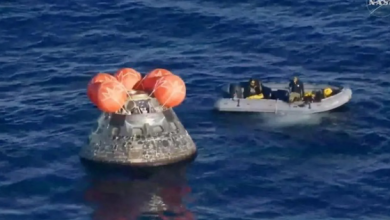
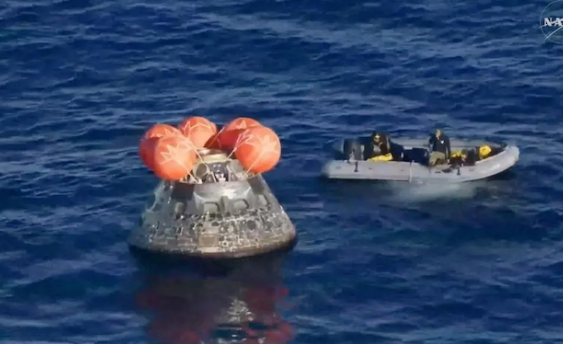
The Orion capsule, named “Integrity,” re-entered Earth’s atmosphere before deploying parachutes and landing in calm waters off the Southern California coast shortly after 5:07 p.m. Pacific Time, in what officials called a “textbook touchdown.”
Commander Reid Wiseman confirmed after landing that the crew was “happy and healthy,” following a safe re-entry that included a six-minute communications blackout as the spacecraft endured extreme atmospheric heat.
The crew, pilot Victor Glover and mission specialists Christina Koch and Jeremy Hansen travelled about 252,756 miles from Earth, reaching a maximum distance of 406,771 kilometres, setting a new record for the farthest humans have ever travelled into space.
The mission marked the first time humans had reached the Moon’s vicinity since the Apollo era, ending a gap of more than five decades in deep space exploration.
NASA officials described the mission as a turning point in space exploration, stating: “This is the start of a new era of human space exploration,” as preparations continue for future lunar landings.
During the flight, the crew conducted observations of the Moon, capturing images, sketches, and voice recordings as they orbited Earth’s nearest celestial neighbour.
Reflecting on the experience, Victor Glover said “no adjectives” could fully describe what they witnessed during the mission.
The Artemis II mission, part of NASA’s broader Artemis program, aims to return humans to the Moon by 2028 and eventually establish a sustained lunar presence.