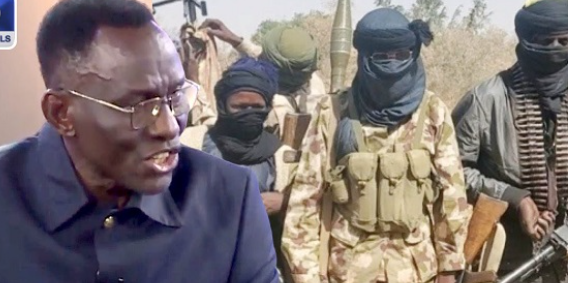
Former Chief of Defence Staff (CDS), General Lucky Irabor (retired), has firmly debunked claims circulating in some quarters that ex-Boko Haram members who have surrendered are being enlisted into the Nigerian Armed Forces.
Speaking on Politics Today, a Channels Television programme, on Monday, Irabor said there is no possibility structural or procedural for former insurgents to be recruited into the military, describing the speculation as unfounded and misleading.
“I honestly do not understand where this notion came from,” he said. “It is impossible.
”The idea that repentant terrorists are being drafted into the military simply does not exist.”
Irabor, who served in key command roles during the height of the insurgency, stressed that his experience across multiple operational fronts gives him first-hand knowledge of how recruitment and security vetting work within the armed forces.
Before his appointment as CDS, he was Theatre Commander of Operation Lafiya Dole, later Force Commander of the Multinational Joint Task Force, and subsequently Chief of Defence Training and Operations.
He said such extensive exposure makes it clear that no person can enter the military without thorough screening and endorsement from their local government authorities.
“Entry into the military requires layers of clearance, beginning from the local government.
”There is simply no pathway for a former terrorist to pass through that process undetected or approved,” he added.
The former CDS clarified that repentant insurgents fall under the purview of Operation Safe Corridor, a government programme that provides deradicalisation and reintegration support for low-risk individuals who voluntarily surrender.
He said this process has no linkage whatsoever to military recruitment.
While acknowledging that the country still faces significant security challenges, Irabor rejected the narrative that these difficulties stem from incompetence within the security forces.
Instead, he pointed to long-standing gaps in manpower, equipment, and operational resources, as well as the complexity of asymmetric warfare.
He cautioned against equating increased defence spending with immediate results, noting that effective counter-insurgency strategies often require time, patience, and a deep understanding of the root causes of conflict.
“It is not just about how much money is spent,” he said. “It is also about listening carefully, understanding the issues, and addressing them with clarity and focus.”