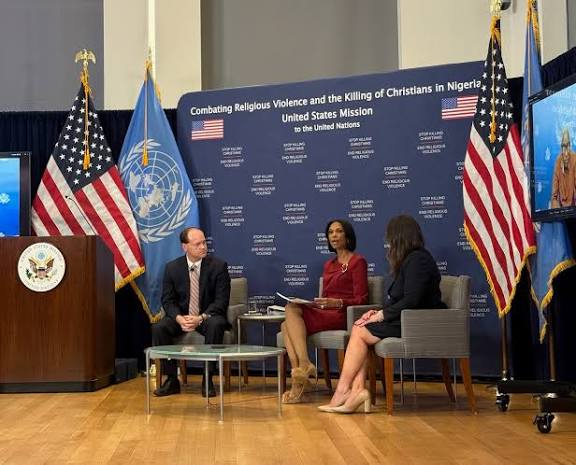
At a high-profile congressional briefing on Capitol Hill on Tuesday, U.S. lawmakers called for stronger diplomatic pressure on Nigeria to abolish Sharia-based criminal laws in its northern states and to disband the Hisbah religious police, citing escalating persecution of Christian communities.
The session, convened in the wake of President Donald Trump’s recent decision to redesignate Nigeria as a “Country of Particular Concern” (CPC) for religious freedom violations, featured testimony from Dr. Ebenezer Obadare, Senior Fellow for Africa Studies at the Council on Foreign Relations.
Lawmakers and experts at the briefing argued that Nigeria’s legal framework and religious enforcement bodies have enabled systematic targeting of Christians, particularly in the country’s northern regions.
Dr. Obadare highlighted that extremist groups, including Boko Haram, the Islamic State West Africa Province (ISWAP), and radicalized factions of the Fulani community, exploit Sharia structures and Hisbah authorities to operate with near-total impunity.
“These institutions provide both legitimacy and operational cover to violent actors,” Obadare told the bipartisan panel, warning that failure to address the legal and ideological underpinnings of extremism would allow attacks to continue unchecked.
Obadare recommended a two-pronged U.S. strategy: enhanced cooperation with the Nigerian military to degrade the operational capabilities of Boko Haram, and sustained diplomatic engagement with President Bola Tinubu to abolish Sharia criminal codes in the 12 northern states that adopted them in 2000, along with the dissolution of Hisbah commissions that enforce religious rules on citizens regardless of their faith.
“These measures are essential if the United States truly seeks to curb religiously motivated violence in Nigeria,” Obadare said, according to a statement released by the House Appropriations Committee.
The lawmakers at the briefing rejected the notion that the recent wave of killings in northern and central Nigeria is primarily driven by disputes over land, water, or grazing routes.
Instead, they cited incidents such as the November 22 abduction of students and teachers from St. Mary’s Catholic School in Niger State as evidence of an organized campaign against Christian populations.
Rep. Mario Díaz-Balart (R-FL), who chaired the session, described intelligence and witness reports pointing to a pattern of what he called “religious cleansing.”
Rep. Chris Smith (R-NJ) referred to Nigeria as “the global epicenter of anti-Christian persecution,” while Rep. Brian Mast (R-FL) called for the disarmament of violent militias and the prosecution of those who sponsor them.
Obadare acknowledged that the Nigerian government has taken some steps following Trump’s CPC redesignation, including intensified airstrikes on Boko Haram targets, recruitment of 30,000 additional police officers, and President Tinubu’s declaration of a national security emergency.
Still, he emphasised the need for sustained U.S. engagement. “The gravest danger to the Nigerian state remains jihadist insurgency, driven by Boko Haram’s ambition to establish an Islamic caliphate,” Obadare said.
“Any solution that does not prioritize the group’s total defeat is doomed from the start.”
Both Republican and Democratic members of Congress expressed support for including new provisions in the FY26 appropriations bill that would link U.S. aid to measurable improvements in security and religious freedom in Nigeria.
Appropriations Committee staff confirmed that they are preparing a report for the President outlining potential conditions on military assistance and other forms of cooperation.
The briefing also featured testimony from Vicky Hartzler, Chair of the U.S. Commission on International Religious Freedom, and Sean Nelson of Alliance Defending Freedom International.
Both advocated for expanded early-warning systems, targeted sanctions, and stricter oversight of U.S. security support to Nigeria.
Nigeria was first designated a Country of Particular Concern in 2020 under President Trump, a status later removed by the Biden administration.
Trump reinstated the designation on October 31, citing escalating violations of religious freedom and warning that U.S. aid could be suspended unless the Nigerian government implemented urgent reforms.
Tuesday’s briefing is part of an ongoing congressional review of Nigeria’s religious freedom crisis.
A separate hearing on November 20, which included senior State Department officials and Nigerian religious leaders, further highlighted Washington’s growing scrutiny of how Nigeria addresses religiously motivated violence.