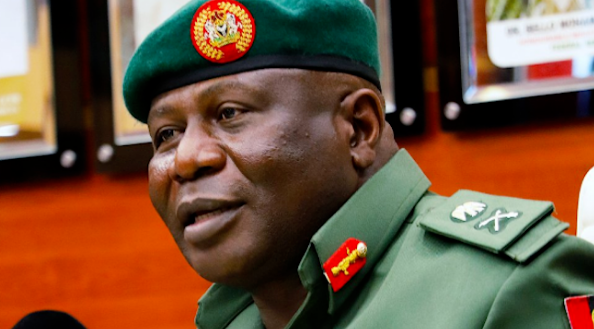
The Armed Forces of Nigeria have commenced a comprehensive review of the 2017 joint military structure to better address evolving security threats and emerging strategic challenges, the Chief of Defence Staff (CDS), General Olufemi Oluyede, announced on Monday.
Speaking at the opening of the 2025 NISECEXPO–DICON International Defence and Security Show at the National Defence College (NDC) in Abuja, General Oluyede said the review sought to strengthen coordination among the Army, Navy, and Air Force, enhance operational effectiveness, and align Nigeria’s defence framework with global best practices.
“The evolving nature of threats, rapid technological advancements, and the need for a more agile force make it imperative to modernise our existing military framework,” the CDS said.
“Our ultimate goal is to bolster national security and overall readiness.”
The review, he explained, would guide future force design, acquisitions, and operational preparedness, ensuring that Nigeria’s military can respond effectively to modern threats.
Among the key initiatives highlighted was the establishment of a Permanent Joint Theatre Command to replace ad hoc joint task forces, creating more enduring and coordinated operational structures.
General Oluyede also revealed the creation of the Joint Doctrine and Warfare Centre, inaugurated less than three months ago, which would develop joint doctrine, deliver integrated training, and advance multi-domain operational concepts.
Planning is also underway for integrated command centres that will enhance situational awareness, accelerate decision-making, and improve coordination across air, land, sea, cyber, and space domains.
Represented by Major General Aniedi Effiong Edet, Director-General of the Joint Doctrine and Warfare Centre, the CDS noted that global defence trends were shifting rapidly towards autonomous systems, robotics, artificial intelligence, and unmanned platforms.
He warned that future conflicts might involve minimal human presence on frontlines, relying heavily on drones, robotics, and algorithm-driven technologies.
“Nigeria must not be left behind,” he emphasised.
The CDS also highlighted the growing importance of cyber and space warfare, with efforts by the National Space Research and Development Agency and the Defence Space Administration focused on strengthening Nigeria’s cyber resilience and space capabilities.
He called on local research institutions to deepen collaboration to boost innovation, doctrine development, and indigenous manufacturing capacity, reaffirming Nigeria’s commitment to both local and international partnerships to enhance strategic depth.
Frank Ohwofa, CEO of NISECEXPO, said this year’s exhibition showcased advanced technologies capable of improving Nigeria’s response to asymmetric threats.
He added that several partnerships and cooperation agreements were expected to be formalised during the event, particularly those supporting local content development—an area deemed critical to national security.
“The ability to produce and maintain equipment locally is essential for reducing strategic vulnerability and achieving self-reliance,” Ohwofa said.
He commended Nigerian companies demonstrating capabilities to manufacture spare parts, vehicles, and other military equipment, noting that such advancements are vital for sustained operational readiness.
The theme of the 2025 edition of the expo is “Future Wars: Operational Endurance and Force Build-up Capabilities.”