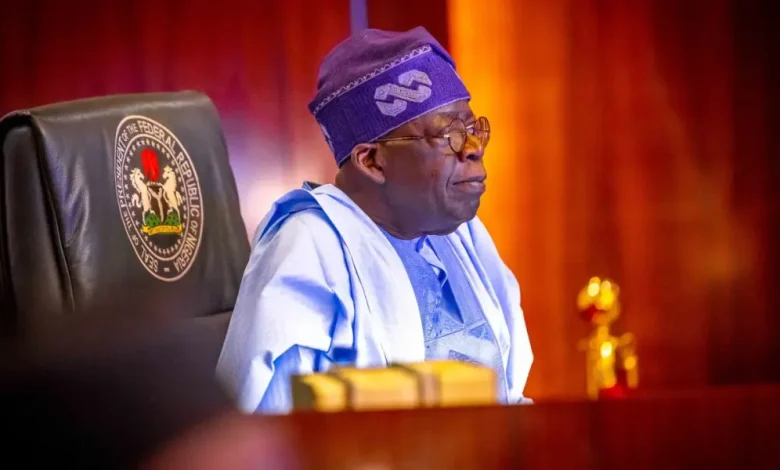
President Bola Tinubu has dismissed claims that Nigeria is experiencing either a Christian or Muslim genocide.
Tinubu insisted that the country’s security challenges were driven by terrorism, criminality and extremism rather than religious persecution.
The President made this assertion on Friday in Abuja while declaring open the eighth biennial conference and annual general meeting of the Nasrul-Lahi-l-Fatih Society (NASFAT).
President Tinubu was represented at the event by the Attorney General of the Federation and Minister of Justice, Mr Lateef Fagbemi.
Speaking against the backdrop of growing international commentary on Nigeria’s security situation, Tinubu said recent allegations portraying the country as a place of religious genocide were false, misleading and dangerous.
Tinubu also warned that such narratives could inflame passions and undermine the fragile fabric of peaceful coexistence among Nigerians.
According to the President, both Christians and Muslims have been victims of terrorist violence, stressing that the attacks do not target any faith exclusively.
He further said Nigerians of different religious backgrounds have consistently stood together in condemning violence in all its forms.
“As President, I reaffirm with a deep sense of responsibility and loyalty to the constitution that there is no Christian genocide in Nigeria and there is no Muslim genocide in Nigeria.
“What we are confronting is terrorism fuelled by criminality and extremism challenges that the government is working tirelessly to overcome, ” he said.
Tinubu noted that the Federal Government had been compelled in recent times to respond to what he described as unfounded and harmful allegations, some of which have gained traction internationally.
He said Nigeria’s official response had been firm and measured, reiterating that the country neither promotes nor tolerates policies or actions aimed at persecuting any religious group.
He explained that the roots of insecurity in Nigeria lie in complex historical, economic and criminal factors, rather than religion, and called on citizens and the international community to resist attempts to frame the crisis along religious lines.
The President reaffirmed his administration’s commitment to national unity, religious freedom and the protection of every human life
Tinubu urged Nigerians to reject divisive narratives whether they originate from within or outside the country.
“Nigeria’s strength has always been its diversity, our ability to live together, worship differently and still see one another as brothers, sisters and compatriots,” he said.
Tinubu commended faith-based organisations such as NASFAT for their role in promoting moderation, tolerance and service to humanity.
He noted that their teachings provided important pathways for resolving conflict and strengthening national unity.
He described differences among Nigerians as a divine design rather than a source of conflict.
Turning to governance and economic reforms, the President said his administration remained firmly committed to building an inclusive, prosperous and secure nation.
He acknowledged that recent economic reforms, while necessary for long-term stability, have imposed temporary hardships on many citizens.
He assured Nigerians that the government was working to ease these pressures, expand social support, accelerate the benefits of reforms and strengthen the country’s security architecture to protect all citizens, regardless of faith, ethnicity or location.
Tinubu however stressed that government efforts alone would not be sufficient, calling on religious and community institutions to help reinforce the nation’s moral and spiritual foundations.
“Good governance must go hand in hand with strong values. Development must be accompanied by discipline, passion and integrity.
”Faith must inspire action,” he said, urging continued partnership in promoting peace, countering misinformation and nurturing unity and patriotism.
Earlier, the keynote speaker at the conference, Dr Nurudeen Lemu, urged Muslims to remain hopeful and steadfast in their faith despite the challenges facing the country.
He encouraged Nigerians to adopt a mindset of building rather than destroying the nation, calling for patience and endurance as essential ingredients for national transformation.
Dr Lemu also emphasised the need for stronger collaboration among faith-based organisations to promote socio-economic development and good governance.
In his remarks, the Secretary General of the Nigerian Supreme Council for Islamic Affairs, Prof. Ishaq Oloyede, described NASFAT as one of the country’s most impactful Islamic organisations.
He said the changing global environment requires a deeper and more dynamic understanding of Islam and its application in public life, while praying for continued strength and progress for the organisation.