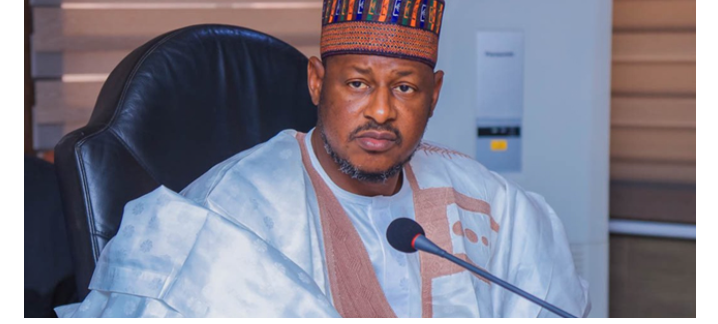
Governor Dikko Raddan of Katsina, has called on Nigerians to reassess the tendency to hold state governments solely responsible for the country’s deepening economic difficulties, arguing that the Federal Government controls the largest share of national revenue.
The governor made the remarks during an interview with Radio France Internationale (RFI) Hausa, where he explained that the existing revenue allocation structure places significant financial limitations on states and local governments, despite public perception that governors command vast resources.
His comments come at a time when state governments are facing increased scrutiny following higher monthly allocations triggered by the removal of fuel subsidies.
Many Nigerians have questioned how these funds are being utilised amid rising living costs.
Radda noted that frustration over economic hardship is often directed at governors and local government chairmen, while the Federal Government’s dominant share of federation revenue is largely overlooked.
“Whenever hardship worsens, people focus their anger on governors and local councils
“But from the federation revenue, 52 per cent goes to the Federal Government.
”The remaining 48 per cent is shared among the 36 states and 774 local governments, ” he said.
According to him, this imbalance has existed for decades, raising important questions about accountability at the federal level.
He challenged Nigerians to ask how the larger portion of national revenue allocated to the centre has been utilised over the years.
The Katsina governor also addressed widespread allegations of corruption often levelled against state governors, describing such claims as unfair generalisations.
He stressed that public office holders should be judged individually rather than collectively condemned.
“Leadership should be assessed on personal integrity.
“It is wrong to label everyone as corrupt. In the end, every leader will answer for his or her actions,” he said.
Defending his administration’s continued focus on capital projects despite economic challenges, Radda argued that infrastructure development is a practical way to stimulate local economies.
He said such projects help circulate money at the grassroots by creating employment and supporting small-scale businesses.
“When capital projects are executed, jobs are created.
”Labourers earn wages, food sellers make sales, and suppliers benefit directly,” he explained.
The governor added that the impact of this approach is already evident across Katsina State, with increased economic activity visible in several local government areas.
“If you visit the local governments today, you will see signs of economic movement because funds are reaching the communities,” he said.
Radda’s remarks added to the ongoing national debate on revenue allocation, governance accountability, and the roles of different tiers of government in addressing Nigeria’s economic challenges.