The Nigerian military has attributed the recent improvement in crude oil output in the Niger Delta to sustained security operations, claiming that the region, historically prone to unrest, has recorded a year without pipeline vandalism.
Speaking during a visit by Defence Correspondents to the Area of Responsibility of Operation Delta Safe, Major-General Emmanuel Emekah, General Officer Commanding 6 Division of the Nigerian Army and Land Component Commander of the Joint Task Force, South-South, said the improved security situation had allowed crude production to rebound to about 2.2 million barrels per day.
“Since assuming command in January 2025, Operation Delta Safe has not recorded any incidents of violent pipeline vandalism within its area of responsibility.
“Before this period, production hovered between 1.4 and 1.5 million barrels daily. With targeted operations and community engagement, output steadily increased, contributing significantly to national economic growth, ” he said.
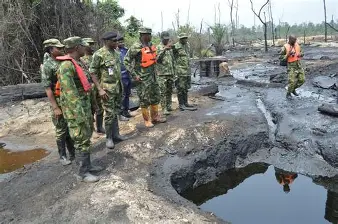
The military official stressed that ongoing efforts aimed at tackling illegal refining and environmental degradation were central to their operations.
He noted that most pipeline issues arose from aging infrastructure rather than deliberate sabotage and that these were promptly addressed with operators.
Emekah highlighted the role of community relations, explaining that dialogue with local leaders and mediation between host communities and oil companies had restored traditional livelihoods such as fishing, while ensuring uninterrupted oil and gas operations.
“The Niger Delta remains the backbone of Nigeria’s economy, and the performance of the oil sector is a critical measure of our operational effectiveness,” he said.
He added that Operation Delta Safe’s objectives are in line with the federal government’s plan to achieve three million barrels per day by 2027.
Major-General Michael Onoja, Director of Defence Media Operations, expressed optimism that sustained inter-agency collaboration would gradually reduce insecurity nationwide.
He commended the sacrifices of personnel, particularly troops deployed under challenging conditions, often away from their families for extended periods.
Onoja called on all stakeholders, including communities and the media, to actively support security initiatives, reiterating that peace in the Niger Delta was essential for Nigeria’s economic stability.
“Security is a collective responsibility,” he said. “With continued effort and cooperation, insecurity will gradually become a thing of the past.”
The military’s report comes amid renewed attention on the Niger Delta, where oil production disruptions have historically undermined national revenue.
Officials said that sustained operations, environmental protection, and community engagement remain critical pillars for ensuring stability and supporting Nigeria’s economic goals.