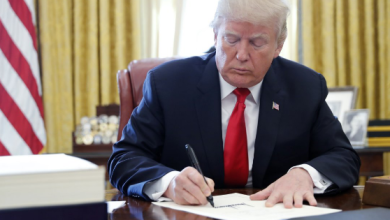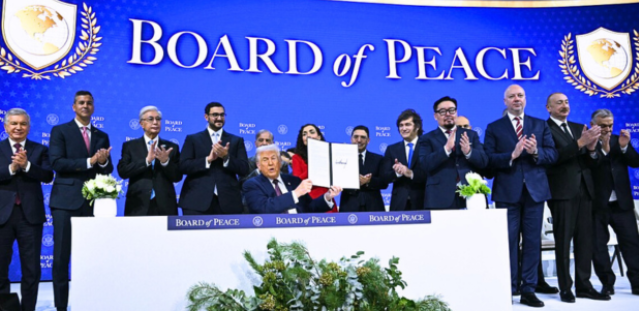
U.S. President Donald Trump officially launched the “Board of Peace” on Thursday at the World Economic Forum, signing the founding charter in a ceremony attended by world leaders from 19 countries.
The organisation, initially conceived to oversee post-war recovery in Gaza, now signals a broader ambition to mediate international conflicts, prompting concerns it could compete with the United Nations.
Trump, who serves as chairman, described the participating leaders as “mostly popular, some not so,” in a candid acknowledgment of the polarized global reactions to the initiative.
On stage, officials including Paraguay’s President Santiago Pena, Pakistan’s Prime Minister Shehbaz Sharif, Kosovo’s President Vjosa Osmani, Argentina’s President Javier Milei, Hungary’s Prime Minister Viktor Orban, and others signed the charter alongside Trump.
The Board’s permanent membership comes with a $1 billion fee, a stipulation that has drawn criticism and fueled claims that it risks becoming a “pay-to-play” alternative to the UN Security Council.
Despite this, Trump emphasised that the board would operate “in conjunction” with the United Nations.
Among the invited members is Russian President Vladimir Putin, whose four-year war in Ukraine has unsettled many Western allies.
Trump confirmed Putin had accepted the invitation, while the Kremlin stated that Moscow was still reviewing the proposal.
Several traditional U.S. allies opted not to attend, including Britain and France, reflecting growing skepticism. Observers noted that most participants had close political or personal ties to Trump.
Other signatories include officials from Bahrain, Morocco, Armenia, Azerbaijan, Bulgaria, Indonesia, Jordan, Kazakhstan, Kosovo, Pakistan, Paraguay, Qatar, Saudi Arabia, Turkey, the UAE, Uzbekistan, and Mongolia.
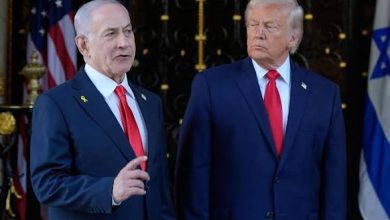
Israeli Prime Minister Benjamin Netanyahu, who faces an ICC warrant over Gaza, pledged to join at a later date.
U.S. Secretary of State Marco Rubio underscored the board’s immediate focus on solidifying a lasting ceasefire in Gaza.
Trump, in turn, warned Hamas to disarm under the next phase of the accord, stating that failure to comply would mark “the end of them.”
Putin has heightened tensions regarding ongoing negotiations to end the conflict in Ukraine.
Trump is scheduled to meet President Volodymyr Zelensky later in Davos to discuss a potential ceasefire.
Trump’s special envoy, Steve Witkoff, indicated that peace talks with Moscow had “progressed significantly” and boiled down to a single unresolved issue, though details were withheld.
Following the ceremony, Trump and his team plan to fly to Abu Dhabi for “military-to-military” discussions with Ukrainian and Russian counterparts, aiming to further stabilise the region.
Zelensky has expressed concern that Trump’s Greenland initiative could overshadow efforts to resolve the war in Ukraine.
In a related development, Trump announced he had reached a preliminary “framework” with NATO chief Mark Rutte, allowing him to delay tariffs initially set to affect European allies on February 1.
Analysts suggested that this may be tied to renegotiating a 1951 Greenland defense agreement, though details remain sparse.
The Davos launch of the Board of Peace signals Trump’s continued effort to project influence on the global stage, drawing both supporters eager to see new approaches to conflict resolution and critics warning against undermining established multilateral institutions.