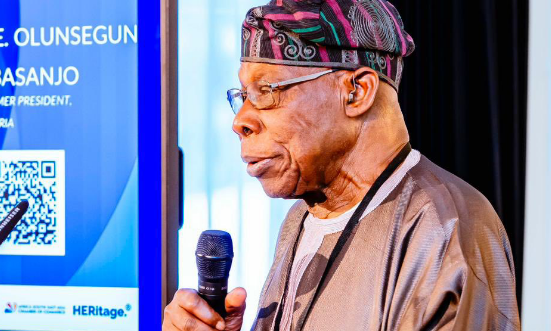
Former Nigerian President, Olusegun Obasanjo, has called for a far-reaching reform of the global financial system, warning that Africa and other developing regions will struggle to achieve sustainable growth unless long-standing funding structures are fundamentally rethought.
Speaking during an interview with Arise News Channel on the sidelines of the World Economic Forum (WEF) in Davos, Switzerland, Obasanjo said Africa must urgently chart a new financial path as traditional sources of development funding continue to dry up.
He noted that shrinking international aid and escalating debt levels have combined to severely limit the continent’s development prospects.
According to the former president, defining what he described as a “sovereign future” for Africa has become increasingly important at a time when Official Development Assistance (ODA) is declining worldwide.
He explained that many African countries are now burdened by unsustainable debt, which has constrained their ability to invest in vital sectors such as infrastructure, healthcare, education and industrial development.
Obasanjo stressed that Africa and the wider Global South can no longer rely primarily on external assistance to drive growth, urging governments and stakeholders to embrace innovative, homegrown financing solutions tailored to local realities.
He disclosed that discussions at this year’s Davos meeting were focused on pushing for a new global financial resource framework that better supports development in Africa and other emerging economies.
He described the effort as a collective search for alternative financial architectures capable of addressing long-standing inequalities in the global system.
As part of this push, Obasanjo announced the launch of a new initiative known as the “Accra Reset.”
The initiative, he explained, is designed to rethink how development resources are mobilised and deployed across Africa and the Global South, with an emphasis on sustainability, inclusiveness and practical outcomes.
He said the initiative aims to move beyond rhetoric by identifying realistic and innovative approaches to financing development, warning that without such reforms, efforts to lift living standards and promote broad-based growth across the continent would remain severely limited.
The former president maintained that meaningful progress in improving the lives of Africans depends on bold changes to the current financial order, arguing that incremental adjustments would not be sufficient to address the scale of the challenges facing the continent.
The World Economic Forum in Davos annually convenes world leaders, policymakers, business executives and development experts to deliberate on major global economic, political and social issues.