President Bola Tinubu has called for stronger World Bank support to advance Nigeria’s economic reforms, with particular emphasis on agriculture, youth employment, and private sector-led growth.
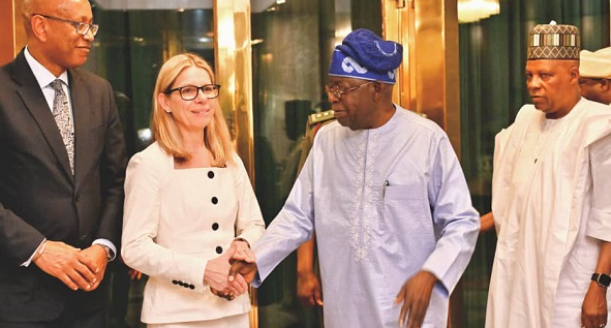
The president made the appeal on Tuesday while receiving a high-level delegation from the World Bank, led by its Managing Director of Operations, Anna Bjerde, at the Presidential Villa in Abuja.
The meeting focused on sustaining Nigeria’s reform agenda and expanding opportunities for millions of citizens, especially young people.
Tinubu said his administration remained fully committed to reforms despite the initial hardships they imposed on citizens, stressing that there would be no retreat from policies aimed at stabilising and restructuring the economy.
He noted that agriculture occupies a central place in the reform programme, describing mechanisation and modern farming practices as essential tools for boosting productivity, ensuring food security, and creating large-scale employment.
According to the president, the government is investing in mechanisation centres that provide farmers with access to modern equipment, improved seedlings, and fertilisers.
He explained that the long-term objective is to transition farmers from small, subsistence operations into large cooperatives capable of competing commercially and generating jobs.
Tinubu also highlighted efforts to strengthen local industries, including the petrochemical sector, as part of a broader strategy to expand domestic production and reduce dependence on imports.
He said economic reforms must be continuous and anchored on transparency, accountability, and policy stability.
Addressing concerns about inflation and currency volatility, the president said inflationary pressures that followed the initial reform measures had eased significantly, while the naira had stabilised.
He added that government policies were now focused on improving the ease of doing business, reducing bureaucratic bottlenecks, and equipping Nigerians with relevant skills.
In her response, Anna Bjerde commended the Tinubu administration for maintaining a consistent and disciplined reform approach over the past two years.
She described Nigeria as a reference point for reform implementation globally, noting that clear communication and policy direction had helped restore investor confidence.
Bjerde emphasised that job creation, particularly for young people, remains a critical challenge across Africa, adding that small and medium-sized enterprises are key drivers of employment.
She identified agriculture as a major sector with vast potential for expansion through mechanisation, cooperative farming, value-chain development, and infrastructure investment.
The World Bank official disclosed that the institution has committed significant financial support to Nigeria, including about $17 billion in public sector financing, $5 billion in private sector funding through the International Finance Corporation, and over $500 million in investment guarantees.
She said these financial instruments align with Nigeria’s reform priorities in trade, digital development, inflation management, and private sector growth, while also supporting human capital development, including early childhood education.
The meeting underscored the Federal Government’s determination to attract international partnerships to drive reforms in critical sectors, particularly those linked to food security, youth employment, and sustainable economic growth.