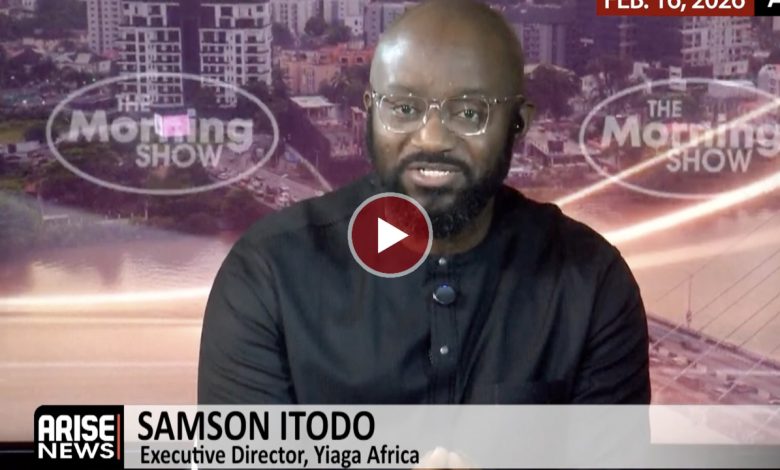
Samson Itodo, Executive Director of Yiaga Africa, has raised concerns over potential obstacles to Nigeria’s 2027 general elections, citing legislative delays, political maneuvering, and possible clashes with religious observances as factors that could undermine voter participation and public confidence in the electoral process.
In a Monday interview with Arise News, Itodo acknowledged that the Independent National Electoral Commission (INEC) acted correctly in releasing its election timetable, but cautioned that adjustments are likely given ongoing political and legislative complexities.
“INEC did not in any way err in law. It has performed its duty. We all know that timetable will likely be revised, and INEC will have to issue an updated schedule.
”It is noteworthy that February 20th, 2027, was initially set for the Presidential and National Assembly elections,” Itodo said.
He flagged potential scheduling conflicts with religious calendars, noting the overlap with both the Muslim fasting period and the Christian Lenten season.
“Some of the dates under consideration are not static. If elections are moved to accommodate religious observances, we could face a very tight timeline.
”For instance, holding the election after Easter would leave only 29 days to meet all deadlines. That is far too narrow, particularly if there are runoffs or reruns,” he explained.
Beyond logistical issues, Itodo warned of deliberate political strategies aimed at sowing confusion.
“A section of the political class is leveraging uncertainty to overstretch our institutions.
”Weekly absurdities in policy are designed to discourage citizens from questioning the process and ultimately reduce voter turnout. Low participation makes manipulation far easier,” he added.
Funding remains another point of concern. Itodo questioned whether INEC would secure sufficient resources in time, citing delays in budget allocations for past elections.
“If past experience is anything to go by, INEC may not receive full funding ahead of 2027. Consider the economic climate today and the funding delays we’ve seen after the 2023 elections,” he noted.
Itodo also expressed reservations about recent amendments to the Electoral Act, which could compromise the integrity of electronically transmitted results.
“The provision is unambiguous, but it does not fully confer legitimacy on electronically transmitted outcomes.
”If the default legal position overrides electronic transmission, the system is open to manipulation,” he said.
He further highlighted conflicting data on network coverage, pointing to inconsistencies from the Nigerian Communications Commission (NCC) regarding polling unit connectivity.
“In 2022, NCC told INEC that 93 per cent of polling units had network coverage.
”Today, some claim 97 per cent, yet senators have indicated the actual coverage is lower. This appears to be an effort to misinform or control the process.
“It is evident that political elites, rather than citizens or institutions, are responsible for these emerging electoral uncertainties.
” If transparency is compromised, the blame rests squarely on the political class,” he said , urging lawmakers to prioritise public interest over partisan concerns.
Itodo also appealed to the ongoing conference committee to adopt provisions consistent with citizens’ demands.
“Nigerians are watching, and they hope the committee will act in the interest of transparency and fairness. This is where the country should be headed,” he said.