President Donald Trump on Saturday announced a sweeping increase in the United States’ baseline tariff on imports, raising the global rate to 15 per cent in a dramatic escalation of his administration’s trade agenda.
The decision came less than 24 hours after the Supreme Court of the United States delivered a major legal blow to his tariff framework, ruling 6–3 that key elements of the policy were not authorised under a 1977 economic emergency powers statute.
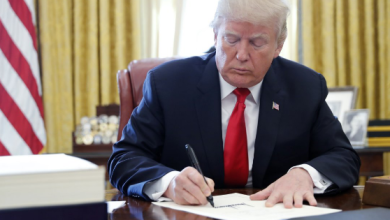
In a post on his Truth Social platform, Trump described the court’s ruling as “extraordinarily anti-American” and declared that his administration would immediately adjust the tariff to what he termed the “fully allowed, and legally tested” 15 per cent ceiling.
Following Friday’s ruling, Trump had initially introduced a 10 per cent global levy using an alternative legal justification.
Saturday’s move not only increased the rate but also signalled the president’s determination to maintain pressure on U.S. trading partners despite judicial resistance.
The high court’s decision represented one of the most consequential rebukes of Trump’s economic programme since his return to office 13 months ago.
While the court has often ruled in ways that expanded executive authority during his presidency, this decision curtailed his ability to rely on emergency powers for broad tariff impositions.
In a pointed reaction, Trump publicly criticised members of the conservative wing of the bench who sided with the majority, accusing them of disloyalty.
At the same time, he praised Justices Clarence Thomas, Samuel Alito, and Brett Kavanaugh — whom he nominated during his first term for voting to uphold his authority.
Under federal law, the newly imposed 15 percent tariff can remain in effect for up to 150 days.
The White House indicated that exemptions would continue for goods covered under the United States–Mexico–Canada Agreement, as well as sectors such as pharmaceuticals that are already subject to separate investigations.
Import duties previously imposed on steel, aluminium, and other specific industries remain untouched by the ruling, and additional sector-based tariffs could emerge from ongoing government probes.
The administration also confirmed that countries which negotiated bilateral tariff arrangements with Washington would not be shielded from the global levy, adding another layer of complexity to international trade relations.
Despite the political turbulence, Wall Street responded calmly. Major US indices edged higher on Friday, reflecting expectations that the court might rein in the administration’s broad tariff authority.
Business groups broadly welcomed the ruling. The National Retail Federation said the judgment provided “much-needed certainty” for companies navigating fluctuating trade policies over the past year.
During court arguments, administration lawyers had assured that importers would be eligible for refunds if tariffs were ultimately found unlawful.
However, the Supreme Court did not provide explicit guidance on reimbursement procedures.
Trump acknowledged that disputes over potential refunds could trigger years of litigation, with Justice Kavanaugh warning that any repayment process could prove complicated.
Saturday’s escalation is expected to heighten uncertainty across global markets, as Washington’s trade policy continues to shift rapidly.
Over the past year, tariff levels on goods entering the United States have been repeatedly revised, suspended, or expanded affecting both long-standing allies and strategic competitors.
The latest announcement underscores Trump’s commitment to a confrontational trade posture, even in the face of legal challenges and diplomatic pushback.
As the 150-day clock begins, businesses and foreign governments alike are bracing for what could become another prolonged chapter in America’s intensifying trade war.