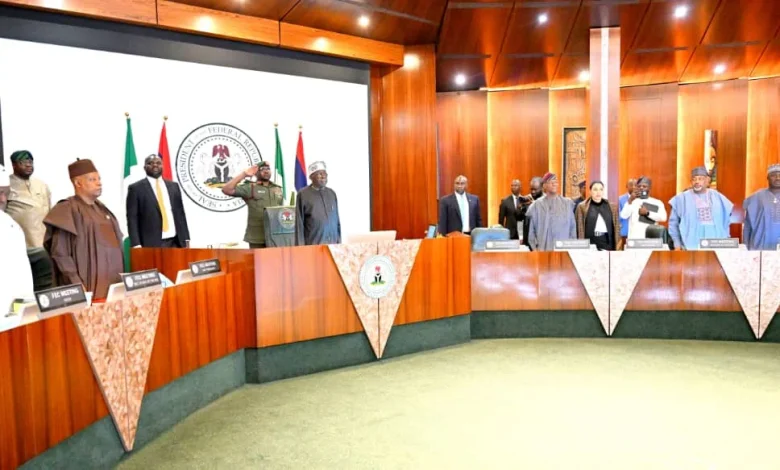
The Federal Executive Council (FEC) on Wednesday approved a series of policy measures and infrastructure projects aimed at addressing pressing economic and social challenges across Nigeria.
The meeting, presided over by President Bola Tinubu at the State House, Abuja, focused on reforms in the power sector, civil service welfare, roads and bridges, healthcare, and education.
Briefing journalists after the FEC meeting, the Minister of Information and National Orientation, Mohammed Idris, said President Tinubu is considering the creation of a Grid Asset Management Company to tackle persistent problems in the nation’s electricity transmission network.
Idris explained that the transmission segment remains the key bottleneck in Nigeria’s power value chain.
“The President has said that the problem mainly in our quest to solve the power problem is largely in the transmission section.
”Therefore, Mr President came with a bill mulling the idea of setting up what is called the Grid Asset Management Company,” he stated.
A multi-ministerial committee, comprising the Ministers of Power, State for Gas, Works, Finance, Science and Technology, and the Chairman of the Nigeria Legal Service, will develop the legal, regulatory, and operational framework before the proposal is presented to the National Assembly.
The council approved a new exit-benefit scheme for retiring civil servants under the Contributory Pension Scheme.
The scheme allows workers in treasury-funded ministries, departments, and agencies to receive up to 100 percent of their total emoluments as additional retirement benefits, a move designed to boost morale and efficiency within the civil service.
Senator David Umahi, Minister of Works, announced that FEC approved several stalled and new road and bridge projects including the revival of the Suleja–Minna Road project, with part of the work now awarded to CGC and CCECC following the termination of the original contractor.
The sum of N5.6 billion allocated to Advanced Engineering Consultants for design and costing of Carter Bridge demolition and reconstruction in Lagos.
Reconstruction of strategic road corridors including Kano–Kongolam Road (Kano, Jigawa, Katsina), Abuja–Lokoja, Ibadan–Ife–Ilesa dual carriageway, and Phase Two of Keffi–Nasarawa–Abaji road.
Umahi said the government aimed to complete at least four major infrastructure projects in each geopolitical zone for presidential commissioning by May 15.
FEC also approved N9.99 billion for the procurement of antiretroviral drugs to sustain Nigeria’s HIV treatment programme.
The contract was awarded to Fixing HealthCare, which would collaborate with international partners to strengthen local pharmaceutical manufacturing.
Additionally, FEC approved upgrades and training support for radiotherapy services in six cancer treatment centres, one in each geopolitical zone.
The council approved a six-year moratorium on the establishment of new tertiary institutions—including universities, polytechnics, and colleges of education—to focus on improving quality in existing institutions.
Minister of Education Dr. Olatunji Alausa said Nigeria now has sufficient tertiary institutions, and the government’s priority must be to strengthen these institutions and ensure financial sustainability for private universities.
FEC also restored the National Commission for Mass Literacy, Adult and Non-Formal Education as an independent commission, reversing its earlier conversion into a department within the Ministry of Education.
Alausa stated that this move would enhance literacy and digital education, particularly in rural communities.