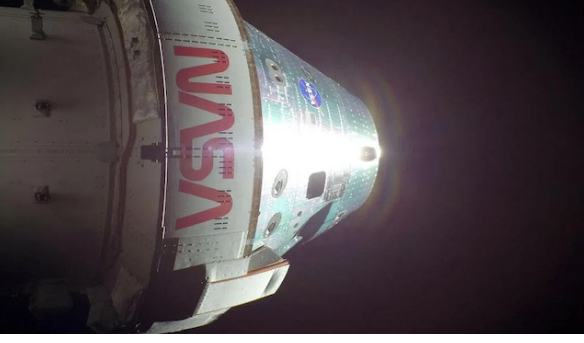
In orbit beyond the far side of the Moon, history-making astronauts of NASA’s Artemis II mission reflected on the emotional and scientific milestones of their unprecedented journey, ahead of a dramatic re-entry into Earth’s atmosphere.
The four-member crew, traveling aboard the Orion capsule since its launch from Florida last week, are scheduled to splash down off the Southern California coast on Friday evening.
During their voyage, the astronauts passed the Moon’s shadowed far side, achieving the farthest distance ever traveled by humans in history.
On their return, the crew would face re-entry speeds of up to 23,839 mph (38,365 kph), a phase that would put Orion’s heat shield to the ultimate test against the intense friction of Earth’s atmosphere.
“I’ve actually been thinking about entry since April 3, 2023, when we got assigned to this mission,” said mission pilot Victor Glover during the first press conference held from space on Wednesday.
“There’s so many more pictures, so many more stories, and gosh, I haven’t even begun to process what we’ve been through.
”We still have two more days, and riding a fireball through the atmosphere is profound as well.”
Fellow NASA astronauts Reid Wiseman and Christina Koch, along with Canadian astronaut Jeremy Hansen, made up the Artemis II crew.
They are the pioneers of a multibillion-dollar series of Artemis missions, which aim to return humans to the Moon by 2028 and establish a long-term U.S. presence as a stepping stone for future Mars exploration.
Koch likened the Artemis mission series to a relay race.
“In fact, we have batons that we bought to symbolise, physically, that.
”We plan to hand them to the next crew, and every single thing that we do is with them in mind,” she said.
Looking ahead, Artemis III would conduct a docking test in low-Earth orbit between Orion and lunar landers intended for future Moon missions.
Artemis IV, targeted for 2028, is expected to mark the first crewed lunar landing since Apollo 17 in 1972.
Back on Earth, NASA’s Mission Control in Houston closely monitored the crew’s activities, reviewing both real-time and recorded audio to ensure mission safety and gather scientific insights.
The crew is expected to return on Friday around 8 p.m. ET (0000 GMT Saturday), completing a nearly 10-day mission.
On Monday, they set a new record by traveling roughly 252,000 miles from Earth, surpassing Apollo 13’s previous distance by approximately 4,000 miles.
Wiseman revealed that each astronaut had two brief video calls with family during the mission.
Hansen proposed naming a newly observed lunar crater after Wiseman’s late wife, Carroll, producing an emotional moment shared by the crew and mission control staff.
During a six-hour lunar flyby, the astronauts surveyed the Moon’s surface from roughly 4,000 miles above, providing real-time observations that allowed scientists on the ground to engage in rare interactive discussions with a crew in deep space.
Describing the Moon as a “witness plate” to the solar system’s formation, Koch emphasized that Artemis II represents a critical early step in unlocking the mysteries of Earth’s planetary neighborhood.