President Bola Tinubu on Wednesday received former President Goodluck Jonathan at the State House, Abuja, in a meeting that underscored ongoing political consultations on West African affairs and broader continental engagements.
The visit, which took place at about 4 p.m., was held inside the President’s first-floor office and was described as part of continued dialogue between both leaders on regional developments.
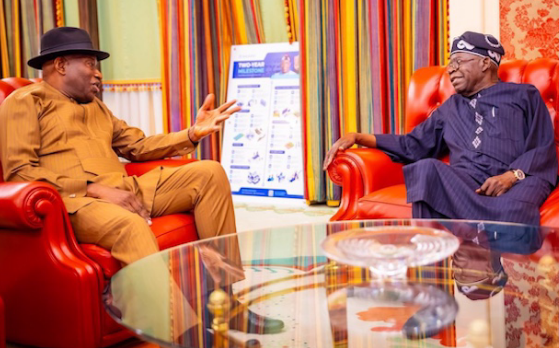
Presidential spokesperson, Bayo Onanuga, confirmed the meeting and shared photographs on his X account, simply captioning it: “President Tinubu meets former President Goodluck Jonathan at the Villa.”
The images showed both leaders engaged in a relaxed and cordial discussion, with a document marked “Two-Year Milestone” visible within the office setting.
Although no official details were released on the agenda of the talks, the engagement is believed to be linked to Nigeria’s diplomatic and regional responsibilities within West Africa.
Jonathan’s latest visit comes about five months after his previous trip to the Presidential Villa in November 2025, marking a continuation of periodic consultations between both statesmen.
During that earlier visit, Jonathan had just returned from Guinea-Bissau following political unrest that disrupted the country’s electoral process, after soldiers arrested President Umaro Sissoco Embaló ahead of the announcement of election results.
At the time, Jonathan was serving as head of the West African Elders Forum election observation mission and was later evacuated on a private aircraft reportedly arranged by Ivorian President Alassane Ouattara.
Since leaving office in 2015, Jonathan has remained active in regional diplomacy, frequently participating in election observation and mediation efforts across West Africa, including assignments in Mali, The Gambia, Liberia, and Guinea-Bissau.
Wednesday’s meeting adds to a series of high-level consultations in Abuja involving former African leaders and Nigeria’s current administration, particularly on issues of democratic stability and regional security.
Both leaders, however, did not make public statements after the closed-door engagement.