United States President Donald Trump has announced a suspension of a recently launched U.S. military operation aimed at escorting commercial vessels through the Strait of Hormuz, signalling a shift toward renewed diplomatic efforts with Iran to end the ongoing Middle East conflict.
The operation, dubbed “Project Freedom,” was launched on Monday to support maritime traffic through the strategic waterway, following heightened tensions in the region.
However, Trump said the mission would now be paused after just one day of activity.
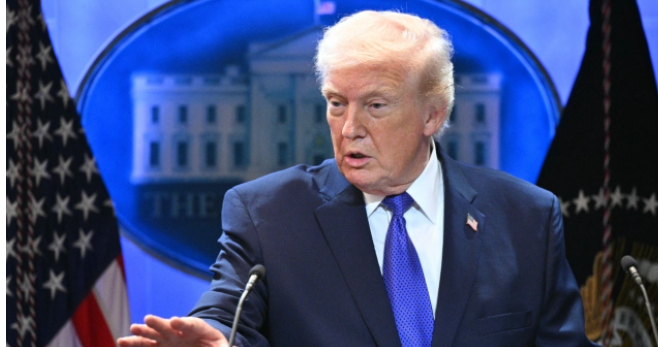
In a post on his Truth Social platform, the U.S. president said the decision followed appeals from mediators, including Pakistan, and other international partners, who encouraged a temporary halt to allow peace negotiations to advance.
“We have mutually agreed that, while the Blockade will remain in full force and effect, Project Freedom will be paused for a short period of time to see whether or not the Agreement can be finalised and signed,” Trump stated.
He also claimed that “great progress” had been made toward what he described as a “complete and final agreement” with Tehran.
Washington continues to enforce a blockade on Iranian ports as part of broader pressure tactics aimed at compelling Iran to reach a settlement and end hostilities that escalated after the outbreak of war on February 28.
The conflict, which involved joint U.S. and Israeli strikes on Iranian targets, reportedly led to the killing of senior Iranian figures and the destruction of key military and economic installations, although it did not result in the collapse of the Iranian government.
Iran has since responded with missile and drone attacks across the region.
A file image shows vessels operating near the Strait of Hormuz, one of the world’s most critical oil transit routes.
Tensions in the area have remained high, with reports of attacks on civilian ships and U.S. claims of striking Iranian boats during earlier operations.
U.S. officials had previously described their military campaign in the region as “defensive” in nature.
Secretary of State Marco Rubio confirmed that offensive operations, referred to as “Operation Epic Fury,” had concluded.
“The operation is over, Epic Fury as the president notified Congress. We’re done with that stage of it,” Rubio said, adding that current activities were not part of an offensive campaign.
He maintained that U.S. forces would only respond if attacked first, stressing that the mission was aimed at deterrence rather than escalation.
“The clashes in the Strait of Hormuz were not part of the original war.
“This is not an offensive operation; this is a defensive operation. And what that means is very simple, there’s no shooting unless we’re shot at first, ” Rubio noted.
Despite the ceasefire declared by Trump on April 8 and later extended, negotiations with Iran have remained largely stalled.
However, U.S. officials insist that pressure on Tehran is producing economic strain and could eventually lead to a diplomatic breakthrough.
Rubio added that the United States believed it had already achieved key objectives of its military engagement.
“These guys are facing real, catastrophic destruction to their economy,” he said, while noting that President Trump still preferred a negotiated settlement with Iran.