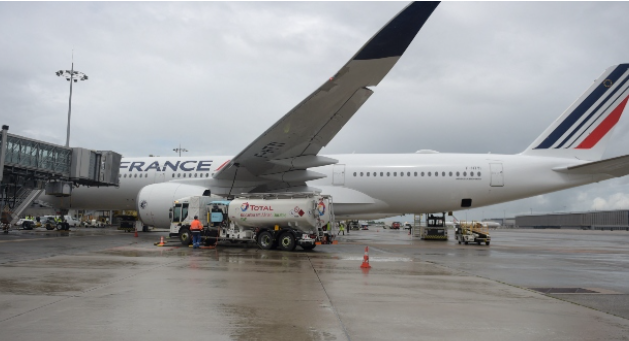
European Union authorities are weighing emergency measures to protect air travel this summer as the ongoing Middle East conflict continues to disrupt global jet fuel supplies and drive up aviation costs.
Although Brussels insisted there are currently no shortages of aviation fuel across member states, officials are increasingly preparing contingency plans amid fears the crisis around the Strait of Hormuz could worsen during Europe’s peak holiday season.
The conflict involving the United States, Israel and Iran has severely affected maritime traffic through the Strait of Hormuz, one of the world’s most important energy transit routes.
Before the outbreak of war, nearly 20 per cent of Europe’s jet fuel imports passed through the waterway.
The disruption has caused aviation fuel prices to surge sharply, raising concerns among airlines already grappling with higher operating costs and reduced profitability.
On Friday, the European Union Aviation Safety Agency (EASA) is expected to issue recommendations on the possible temporary use of Jet A fuel, a U.S.-produced aviation fuel that is not currently approved for widespread use across Europe due to technical standards.
At the same time, the European Commission is preparing to outline measures that member states and airlines can adopt to manage fuel supplies more efficiently during the crisis.
European officials maintained that the bloc is not yet facing an immediate fuel supply emergency, despite mounting pressure on the aviation sector.
“At this stage, this is more a problem of economics and fuel costs than availability,” aviation transport specialist Matteo Mirolo told AFP.
However, he warned that Europe must begin preparing for future disruptions.
“But we do have to think about supply, especially as this will not be the last crisis we face,” he added.
Several airlines, particularly budget carriers, have already announced flight cancellations as fuel prices continue to climb.
EU Energy Commissioner Dan Jorgensen acknowledged on Tuesday that supply concerns could emerge if the conflict persists for an extended period.
“We are not there yet, but it can happen,” Jorgensen said while discussing the growing uncertainty surrounding Europe’s fuel reserves.
To improve oversight, the European Commission announced plans to establish a “fuel observatory” that would monitor production levels, imports, exports and available stockpiles of transport fuels across the European Union.
The monitoring system is expected to become operational within days.
Until now, EU authorities have lacked a comprehensive picture of strategic fuel reserves held by individual member states.
Current European legislation requires countries to maintain oil reserves equal to 90 days of net imports and at least 61 days of domestic consumption.
However, the rules do not distinguish between different petroleum products such as diesel, petrol or aviation fuel.
A commission source said some countries may face greater risks than others. Ireland, for example, was identified as potentially vulnerable because of limited refining capacity, while Finland was described as comparatively well-prepared.
The same source also suggested that some airlines could be taking advantage of the crisis to abandon routes that were already financially weak before the conflict escalated.
While EU officials are not expected to announce sweeping emergency policies immediately, Brussels is seeking to clarify which existing measures can help reduce fuel consumption and ease operational pressure on airlines.
Among the proposals under consideration is a temporary easing of restrictions on “tankering” ,a practice in which aircraft carry additional fuel to avoid purchasing more expensive supplies at destination airports.
The commission is also examining temporary flexibility in airport slot allocation rules.
This would prevent airlines from losing valuable airport slots if they are forced to reduce flights because of soaring fuel costs.
If the crisis continues, EU officials may also coordinate the release of emergency fuel reserves among member states and encourage voluntary sharing of aviation fuel supplies where necessary.
Another major focus is the possibility of turning to alternative fuel sources from the United States.
European regulators are currently reviewing whether U.S.-produced Jet A fuel could temporarily be allowed within the European aviation market.
Jet A differs from the Jet A-1 fuel commonly used across Europe and most international routes.
The American version has a higher freezing point, making it less suitable for extremely cold conditions experienced during long-haul flights.
Because of these technical differences, the fuel is not presently authorised for regular use in Europe.
EU Transport Commissioner Apostolos Tzitzikostas recently confirmed that assessments are ongoing to determine whether temporary exemptions could be introduced safely.
Despite the regulatory challenges, several airlines are reportedly pushing for emergency approval of Jet A fuel before the height of the summer travel season.
In the longer term, European officials say the crisis highlights the urgent need to expand investment in sustainable aviation fuel, commonly known as SAF.
According to Mirolo, the disruption should serve as a wake-up call for governments across Europe.
“The crisis should push states to invest in alternative SAF fuels in civil and military aviation, not only for climate reasons but also for energy sovereignty,” he said.