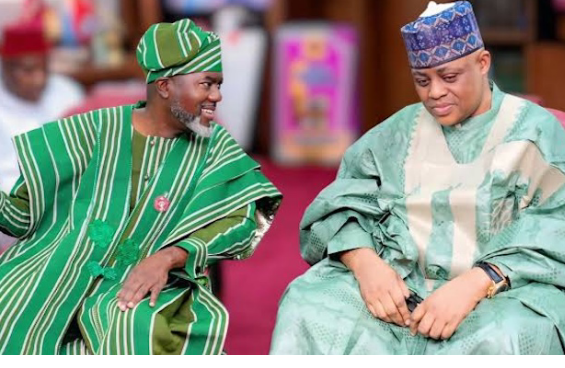
Two Nigerian ambassador-designates, Femi Fani-Kayode and Reno Omokri, have declared support for President Bola Tinubu’s re-election bid in 2027, insisting that power should remain in Southern Nigeria for another term in line with the country’s political power rotation arrangement.
The duo argued that returning presidential power to Northern Nigeria after only one four-year term in the South would undermine national unity, weaken political stability and violate the unwritten zoning understanding that has shaped Nigeria’s democratic system since 1999.
In a joint statement issued on Saturday, the ambassador-designates maintained that the North had already enjoyed two uninterrupted terms under former President Muhammadu Buhari with the support of southern political interests and therefore equity demanded that the South complete its own two-term cycle.
“We view it as unpatriotic and inimical to the unity, equilibrium, and progress of Nigeria for anyone to even conceive of power returning to Northern Nigeria after only one term of four years, during which it was domiciled in Southern Nigeria,” they stated.
The statement stressed that the current presidency in the South was not accidental but a deliberate political arrangement aimed at maintaining balance and fairness in the country.
According to them, Tinubu’s emergence as president carried additional political significance because he played a major role in facilitating the return of power to the North in 2015.
“Not just in Southern Nigeria, but in the specific hands of the man who was the chief architect for the return of power to the North in 2015,” they said.
The two political figures argued that fairness and reciprocity required support for Tinubu’s continuation in office beyond 2027.
“We are of the opinion that one good turn deserves another and that one good term deserves another,” the statement added.
Fani-Kayode and Omokri described the informal rotation of presidential power between the North and South as one of the pillars that helped stabilise Nigeria’s democracy after years of political uncertainty and military rule.
“It is in the best interest of the stability, unity, and prosperity of the Federal Republic of Nigeria, and in keeping with the Gentleman’s Agreement which ushered in our Fourth Republic in 1999, after sixteen years of turbulence and political instability, for there to be a balanced and orderly rotation of power in Nigeria between the North and the South,” they stated.
They also argued that Northern Nigeria had fully utilised its turn in the power-sharing arrangement during the eight-year administration of Muhammadu Buhari and should now allow the South complete its tenure.
According to them, the Buhari administration represented “two terms of four years under the Muhammadu Buhari administration,” which they said had already satisfied the North’s share in the arrangement.
The ambassador-designates also praised President Tinubu’s economic and infrastructure policies under the Renewed Hope Agenda.
They claimed that Nigeria had recorded 12 consecutive cycles of Gross Domestic Product growth and trade surpluses under the current administration.
According to the statement, Tinubu’s policies had added “$67 billion to our economy” and helped position Nigeria as “the sixth largest contributor to global GDP growth in 2025.”
The duo also highlighted several ongoing infrastructure projects, describing them as efforts aimed at strengthening national integration and economic development.
Among the projects mentioned were the N15 trillion Lagos-Calabar Coastal Highway, the N13 trillion Illela-Sokoto-Badagry Superhighway and the Trans-Saharan Road project linking the South-East with Northern Nigeria.
“Finally, we call on all Nigerians, irrespective of region, religion, and communion, to join us and queue behind the present Presidency and future candidacy of President Bola Ahmed Tinubu,” they stated.
They further expressed optimism that Nigeria could become a one trillion-dollar economy by 2031 if the current administration receives broad national support.
Drawing comparisons with Switzerland, Fani-Kayode and Omokri argued that structured political power-sharing among diverse ethnic groups had contributed significantly to the European country’s long-standing peace and stability.
“The reason Switzerland has been stable, peaceful, and prosperous for the last 211 years is because that Alpine nation wisely introduced power sharing amongst its multiethnic population and has not seen any conflict since 1815,” they said.
Reaffirming their support for Tinubu, the duo concluded: “To re-elect President Bola Ahmed Tinubu is a task that must be done.”