Amaewhule accuses Fubara of dishonesty, sparks renewed political tension in Rivers State

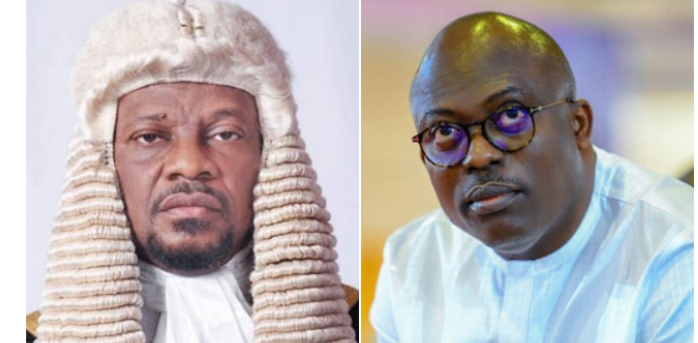
Rivers State is once again experiencing signs of political unrest after the Speaker of the State House of Assembly, Martin Amaewhule, publicly accused Governor Siminalayi Fubara of making false claims regarding his interaction with lawmakers.
The allegation, made on Thursday, has reignited concerns about the fragile political truce in the oil-producing state.
Amaewhule dismissed the governor’s assertion that he had been unable to meet with members of the Assembly, insisting that such a claim was untrue and misleading.
According to the Speaker, the governor had, on several occasions, met with legislative leaders including during a session convened shortly after the lifting of the state of emergency earlier in the year.
He explained that the meeting in question was organised by the Minister of the Federal Capital Territory, Nyesom Wike, and attended by principal officers of the Assembly.
Amaewhule maintained that his presence in the meeting was proof that the governor’s public remarks were inaccurate.
He said the governor’s statements were not only “insincere” but could also fuel unnecessary tension at a time the state was attempting to restore stability.
The Speaker accused the governor of deliberately portraying a communication breakdown between the executive and the legislature, warning that such portrayals risked plunging the state back into political turmoil.
He urged residents of the state to remain alert and not be swayed by what he termed a false narrative.
Governor Fubara, however, stated a day earlier that there was no crisis between his administration and lawmakers from the state, whether at the state or federal level.
Speaking at the commissioning of the expanded Ahoada–Omoku Road project, the governor said insinuations about strained relationships were politically motivated and lacked truth.
He explained that arrangements for a formal engagement with the legislators had already been made and would involve the participation of Wike, elder statesman Ferdinand Alabraba, and other prominent leaders.
Fubara insisted that suggestions that he refused to meet with lawmakers or rejected proposals regarding them were inaccurate.
The governor, who recently defected from the Peoples Democratic Party to the All Progressives Congress, reiterated that his political realignment was driven by the need to maintain peace and foster development.
He urged the people of Rivers State to avoid divisive politics and continue rallying behind President Bola Tinubu and the state leadership.
The relationship between Fubara and his predecessor, Nyesom Wike, deteriorated significantly after the 2023 general elections, leading to a prolonged power struggle over the political structure of the state.
The crisis escalated into a confrontation involving the Amaewhule-led Assembly.
By March 2025, the situation had reached a critical point, prompting President Bola Tinubu to declare a state of emergency.
The decision temporarily suspended both the governor and the state lawmakers and placed the administration of the state under a retired naval chief, Vice Admiral Ibok-Ete Ibas.
The federal intervention was based on intelligence assessments suggesting that the political tensions risked destabilising the state.
The emergency rule remained in place until September 17, 2025, when President Tinubu lifted it, citing improved cooperation among key political actors.
In the months following the declaration of emergency rule, President Tinubu convened a reconciliation meeting involving Fubara, Wike, and Amaewhule, among others.
The discussions appeared to yield progress, as the feuding figures were later seen attending events together.
The suspension of emergency rule was interpreted as a sign that political hostilities had reduced considerably.
However, Amaewhule’s latest accusations suggest that underlying tensions might be resurfacing, raising concerns about the durability of the peace deal and the stability of governance in Rivers State.
Amaewhule Fubara