Bayelsa Medical University: A Legacy Project Rooted in Equity and Vision By Gboluseri Timipre Samuel


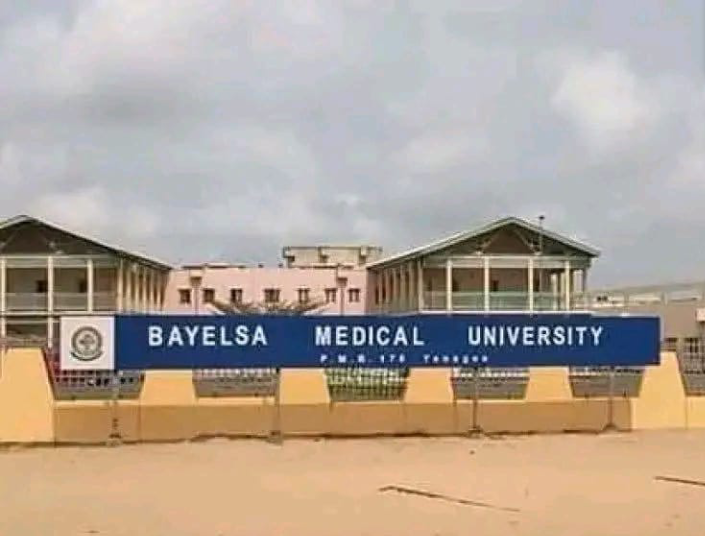
The establishment of Bayelsa Medical University (BMU) in Yenagoa has continued to draw attention as one of the most consequential policy decisions of the Prosperity Administration led by former Governor Seriake Dickson. Beyond bricks and mortar, the university stands as a calculated investment in human capital, economic expansion, and social balance within Bayelsa State—particularly for the Epie-Atissa people, traditional hosts of the state capital.
When the institution was conceived, the Dickson administration faced a delicate question of fairness in the distribution of higher institutions across Bayelsa’s senatorial districts.
Other parts of the state were already home to notable tertiary institutions, including Federal University Otuoke, Niger Delta University, University of Africa, Hensard University, and Ekowe Polytechnic.
Yenagoa, despite its status as the administrative and commercial nerve centre of the state, lacked a flagship institution that reflected its central role in governance and economic coordination.
The creation of Bayelsa Medical University in the capital city was therefore widely interpreted as a corrective measure one that acknowledged the contributions of the Epie-Atissa people while reinforcing Yenagoa’s strategic importance.
It was a move seen not merely as political calculation, but as a deliberate act of inclusion.
Since its establishment, the university has altered the socio-economic landscape of its host community.
Employment opportunities expanded through academic appointments, administrative staffing, and support services.
Local contractors secured projects linked to construction and campus development.
The influx of students and professionals stimulated housing demand, transportation services, retail trade, and hospitality businesses.
Areas that once experienced modest commercial activity gradually transformed into thriving urban corridors.
The impact, however, extends beyond immediate economic gains. Bayelsa Medical University represents a long-term strategy for strengthening local expertise in the health sciences.
By offering specialised medical education within the state, it reduces the need for aspiring doctors, pharmacists, nurses, and laboratory scientists to seek training elsewhere.
This approach not only curbs educational migration but also retains intellectual resources within Bayelsa.
For a region historically challenged by shortages of healthcare personnel, the significance is profound.
The Niger Delta despite its vast contribution to Nigeria’s economy, has long grappled with inadequate medical manpower.
By producing homegrown professionals trained within the environmental and public health realities of the region, BMU directly addresses this structural gap.
Graduates are more likely to understand local disease patterns, cultural dynamics, and community health challenges unique to the riverine terrain.
Equally important is the university’s potential as a research hub. With a focus on tropical medicine, environmental health, and community-based clinical practice, BMU is positioned to contribute to solutions tailored to the Niger Delta’s ecological conditions.
Academic scholarship and innovation emerging from the institution could, in time, elevate Bayelsa’s profile within Nigeria’s medical education landscape.
Observers noted that the project underscores a broader philosophy of governance, one in which leadership is measured by durable institutions rather than short-term political gains.
By prioritising education and healthcare infrastructure, the Dickson administration sought to create structures capable of outlasting any single tenure in office.
As conversations about development and regional equity continue in Bayelsa and beyond, Bayelsa Medical University remains a reference point.
For supporters, it embodies foresight, fairness, and a commitment to posterity.
For the Epie-Atissa people and the wider state, it stands as both a symbol and a functioning institution, one that links today’s policy decisions with tomorrow’s possibilities.